



A Healthcare Software Provider Automates Test Creation with Kualitee’s Hootie AI
Hootie now generates test cases directly from requirements, BRDs, and UI images, freeing a stretched QA team from manual authoring.
Download the Case Study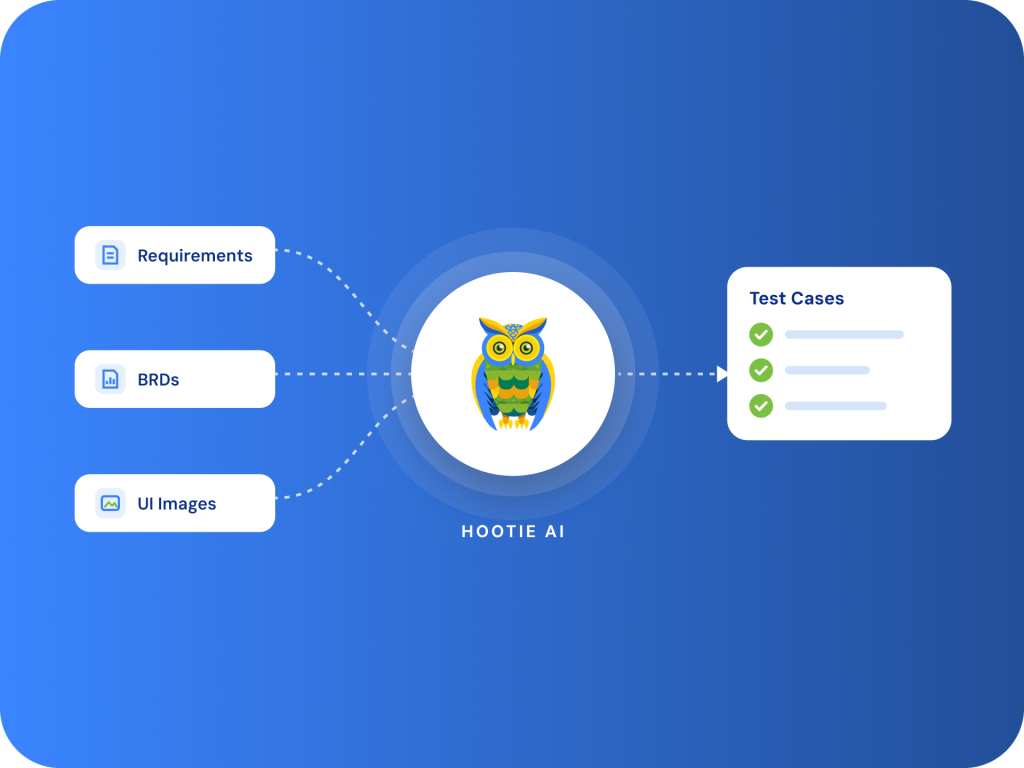
Client Snapshot
The client operates in the healthcare industry, running a software QA function responsible for validating a large and steadily growing set of requirements. Like many healthcare software providers, the volume of documentation the QA team had to translate into test coverage, ranging from individual requirements to full business requirement documents, had grown to a point where manual test case authoring was becoming difficult to sustain.
Background
The client’s QA team was stretched thin, facing a large volume of requirements and BRDs that needed to be converted into test cases faster than their team could manually keep up with. Writing test cases by hand for every requirement, and separately for every BRD that came through, was consuming time the team needed for actual testing, review, and release readiness.
Manual test case authoring was becoming difficult to sustain.
The client was looking for a way to remove that manual bottleneck without compromising on test coverage or quality.
Challenge
The client’s needs centered on reducing manual effort across the test creation process, while also expanding what their QA team could do with AI:
Manual test case creation from requirements. With a stretched QA team and a large volume of requirements coming in, the client needed a way to generate test cases directly from written requirements with minimal manual effort, rather than authoring every case by hand.
Test case generation from UI images. Beyond text-based requirements, the client also wanted the ability to generate test cases directly from UI screenshots and images, giving them a faster path to coverage for interface-driven functionality.
A broader suite of AI capabilities. The client wasn’t looking for a single AI feature in isolation. They wanted a full set of AI-driven capabilities working together, including AI test case generation, AI-driven test execution, AI-based test case coverage analysis, requirement impact analysis, and automatically generated automation scripts.
Requirement generation directly from BRDs. With a large volume of business requirement documents to process, the client needed a way to generate requirements and the test cases tied to them directly from BRDs rather than manually extracting and entering each requirement one by one.
Why They Moved to Kualitee
Given the scale of the client’s requirement and BRD volume relative to their QA team’s capacity, they needed a platform built specifically to remove manual effort from test creation at every stage, from initial requirement to executable test case.
From requirement to executable test case: Requirements → BRDs → Hootie AI → Test Cases
Kualitee’s Hootie AI was built for exactly this kind of workload, offering AI-driven capabilities across the full requirement-to-test-case pipeline rather than a single point solution.
Solution
Hootie AI addressed each part of the client’s workload directly:
AI test case generation from requirements. Hootie generates structured test cases directly from written requirements, letting the client’s QA team turn requirements into coverage without writing each case manually.
Test case generation from UI images. The client can upload a screenshot or UI image and have Hootie generate structured test cases from it directly, extending AI-driven generation beyond text-based requirements.
A full AI feature set. Beyond generation, the client now has access to Hootie’s complete range of AI capabilities, including automated test execution, AI-based test case coverage review that flags what’s tested and what’s missing, requirement impact analysis that shows which test cases are affected when a requirement changes, and automatically generated automation scripts for their manual test cases.
Requirement and test case generation from BRDs. Hootie can process a business requirement document directly, extract the individual requirements it contains, and generate test cases against them, removing the need for the client’s team to manually break down each BRD line by line.
Coverage visualization. Alongside the AI capabilities, the client’s Kualitee dashboard was set up with custom charts and graphs, giving the team a clear visual read on their test coverage.
Conclusion
With Hootie AI in place, the client’s QA team no longer has to manually author test cases against every incoming requirement or BRD.
With Hootie AI handling the bulk of test case creation across requirements, BRDs, and UI images, the client’s QA team has been able to redirect the time previously spent on manual authoring toward higher-value testing work, even as their requirement volume continues to grow.
The Kualitee Impact
Test cases generated directly from requirements and from UI images, cutting out manual authoring at the point of creation.
A full AI toolkit covering generation, execution, coverage analysis, requirement impact analysis, and automation scripts, working together rather than as isolated tools.
BRDs converted directly into requirements and test cases, removing manual extraction from the process.
Custom dashboard visualizations giving the team clear visibility into their test coverage.