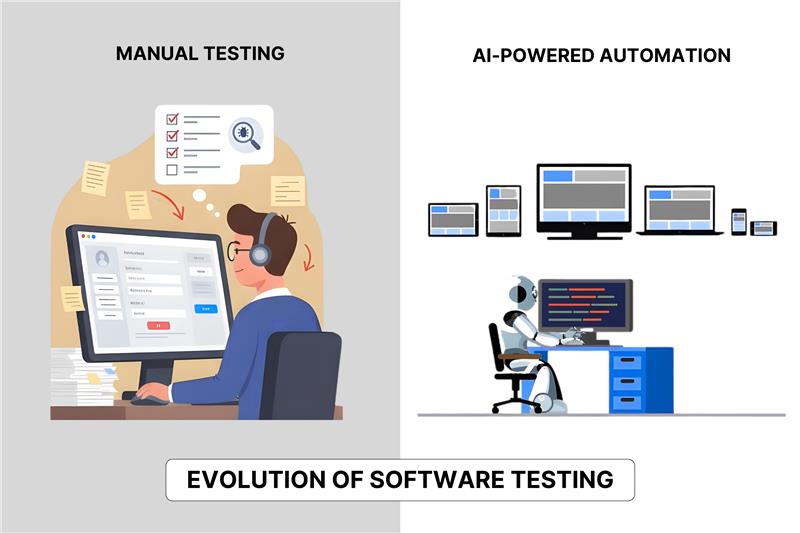




Software testing lifecycle processes have evolved beyond basic checklists into integrated quality gates. Ones that align with business outcomes.
A well-defined quality assurance testing process ensures every release undergoes rigorous, traceable validation. The common pain points, like inconsistent coverage and escaped bugs, have to be addressed as well.
Mature QA processes reduce production defects by catching 95%+ during development, far outperforming ad hoc approaches.
That said, let’s talk about how you can build a foolproof, systematic testing process.
Key Takeaways
- Ad hoc testing does not scale well in modern engineering environments. Without a structured QA workflow, duplicated testing efforts can waste 20% to 30% of QA time, while defect escape rates can rise to 10 to 20% as critical regressions slip through the cracks.
- Mature and systematic testing processes catch 95% or more defects during development. This helps teams maintain less than 5% defect escape rates and prevents costly production failures.
- Fixing defects after release is extremely expensive. Industry estimates show that resolving a bug in production can cost up to 100x more than catching it during development through structured testing practices.
- Risk-based testing allows teams to focus their efforts on critical user journeys and high-impact modules first. Consequently, high-severity defect escapes are reduced by 40% to 60% while using testing resources more efficiently.
- Organizations that implement structured QA frameworks, automation, and data-driven testing practices often see up to 204% return on investment over three years.
Why Ad Hoc Testing Fails at Scale
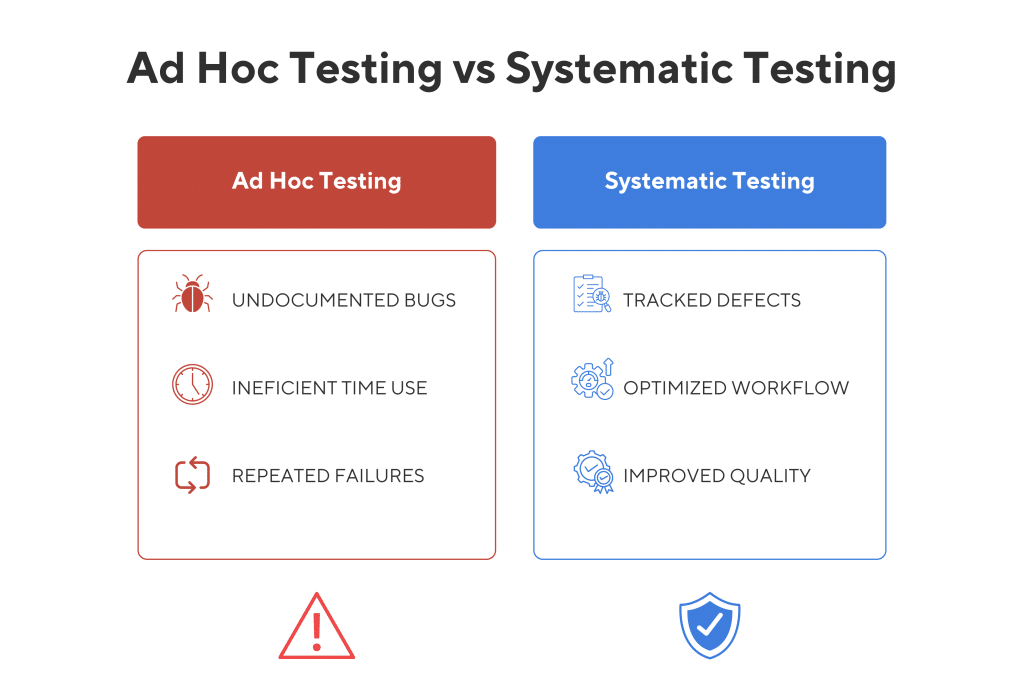
Ad hoc testing shines in quick prototypes or solo debugging sessions. It offers flexibility for exploratory insights without rigid plans.
However, it crumbles in production-scale software testing and QA environments. Especially where engineering teams manage multiple releases, cross-dependencies, and tight deadlines across distributed squads.
Furthermore, without a defined QA testing workflow or structured testing process, critical documentation is spread across emails, shared drives, wikis, and spreadsheets. This fuels miscommunication and knowledge silos that plague growing organizations.
This scattershot approach breeds inefficiency: duplicated test efforts waste 20-30% of QA time, while overlooked regressions slip through unchecked, especially in rapid iteration cycles.
Reddit communities like r/QualityAssurance and r/softwaretesting frequently vent about these pains. Testers recount “test coverage roulette” where one sprint’s thoroughness doesn’t carry over, leaving teams firefighting live incidents.
Engineering leaders also report that inconsistent practices erode velocity, as devs spend more time on hotfixes than innovation.
Want to see how modern teams manage testing end-to-end?
Explore Kualitee and discover a smarter way to handle QA workflows.
The fallout hits hard on quality assurance testing process metrics:
- Skyrocketing Defect Escapes: Rates exceed 10-20% without structure, compared to <5% in mature workflows.
- Exploding Costs: A defect fixed post-release costs 100x more than one caught during development, amplifying to thousands per issue in enterprise apps.
- Team Burnout and Turnover: Reactive testing overloads individuals, leading to 15-25% higher attrition in unstructured QA teams, as heroes can’t scale forever.
- Stakeholder Distrust: Inconsistent releases damage product confidence. This delays features and inflates support tickets by 40%+ during unstable periods.
Core Principles of a Systematic Testing Process
A robust test management process rests on timeless principles that elevate QA from ad hoc checks to a scalable quality assurance testing process.
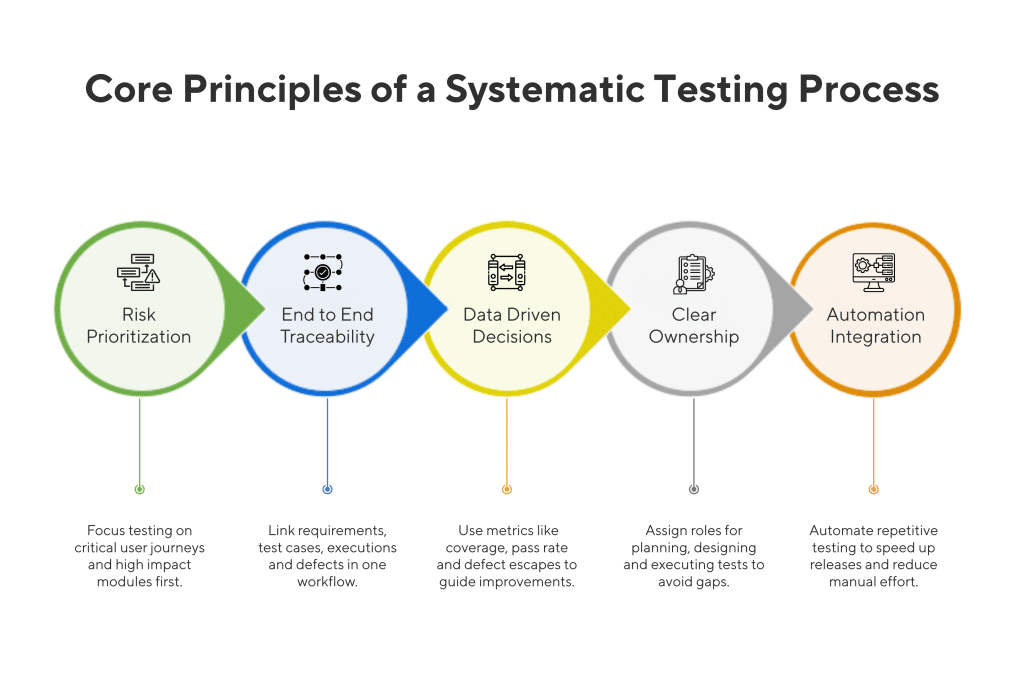
These form the bedrock of any effective software testing strategy, ensuring alignment with development realities while driving measurable gains. Teams embracing them report up to 204% ROI over three years, as per the Forrester TEI Study.
1. Risk Prioritization
Focus testing efforts on high-impact areas first. These can be critical paths, user-facing features, and failure-prone modules. Uniform coverage can be focused on later.
This risk-based QA testing workflow allocates resources efficiently, preventing low-value busywork.
Risk-prioritized testing reduces high-severity escapes by 40-60%, allowing teams to cover more with less. In practice, score risks by likelihood and impact during planning to guide case design.
2. End-to-End Traceability
Link every requirement, test case, execution result, and defect in a bi-directional chain for full visibility.
This traceability in modern QA eliminates “blind testing,” proving coverage and aiding audits.
Without it, most teams struggle with requirement-test alignment. With it, compliance and debugging accelerate.
Centralized matrices visualize gaps, making release gates defensible.
Structured testing needs the right capabilities behind it.
Explore Kualitee’s features to see how teams manage testing at scale.
3. Data-Driven Iteration
Anchor decisions in metrics like coverage, pass rates, and escape rates, reviewing them post-cycle to refine the structured testing process.
Retrospectives turn data into action, such as automating flaky tests.
Agile testing metrics reveal that data-focused teams boost throughput by 65%, shifting QA to proactive optimization.
4. Clear Ownership and Roles
Assign explicit roles, e.g., analysts for requirements, designers for cases, executors for runs. This will help eliminate silos and accountability gaps.
RACI matrices per stage prevent dropped balls in collaborative software testing lifecycle processes.
Furthermore, defined ownership cuts miscommunication by half, fostering team reliability.
5. Automation Integration
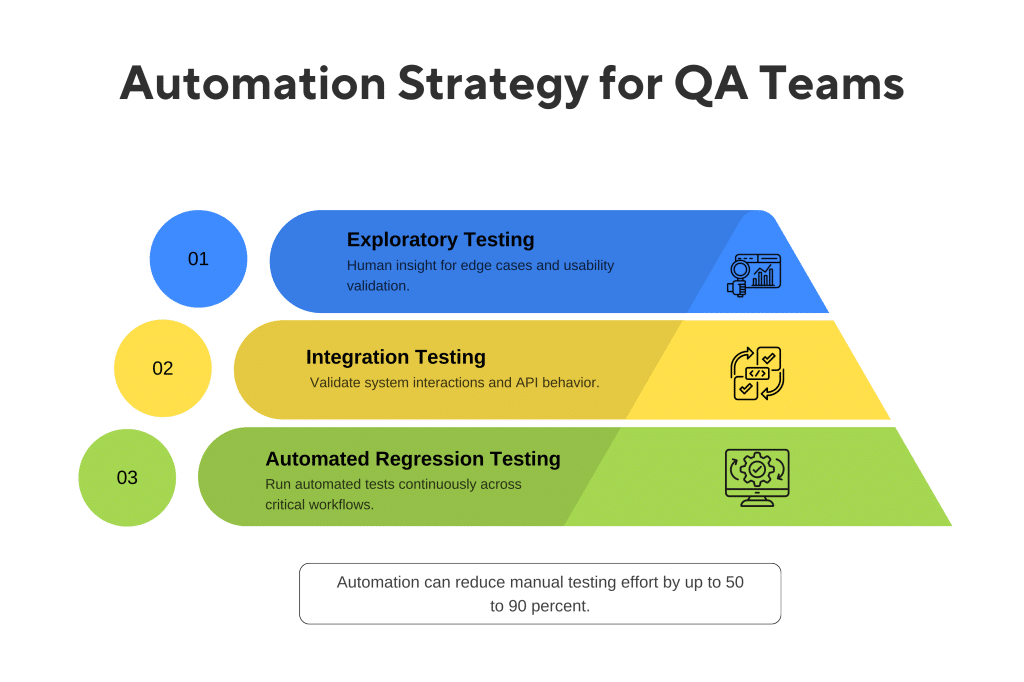
Target repetitive tasks like regressions with automation, freeing humans for exploratory and complex scenarios.
Forrester highlights 70-90% manual time savings in optimized setups, with overall ROI hitting 204% via faster cycles.
Start small: automate 30% of suites initially, scaling as coverage hits 80%.
These principles transform QA from reactive firefighting to a proactive force multiplier.
Curious how a structured testing workflow looks in practice?
Book a demo and see how teams run QA cycles inside Kualitee.
Key Stages in a Structured Software Testing Workflow
A robust software testing lifecycle process follows these sequential yet flexible phases, ensuring comprehensive coverage in any QA testing workflow.
Each stage builds accountability and traceability. It turns raw requirements into validated releases while integrating with Agile sprints or DevOps pipelines.
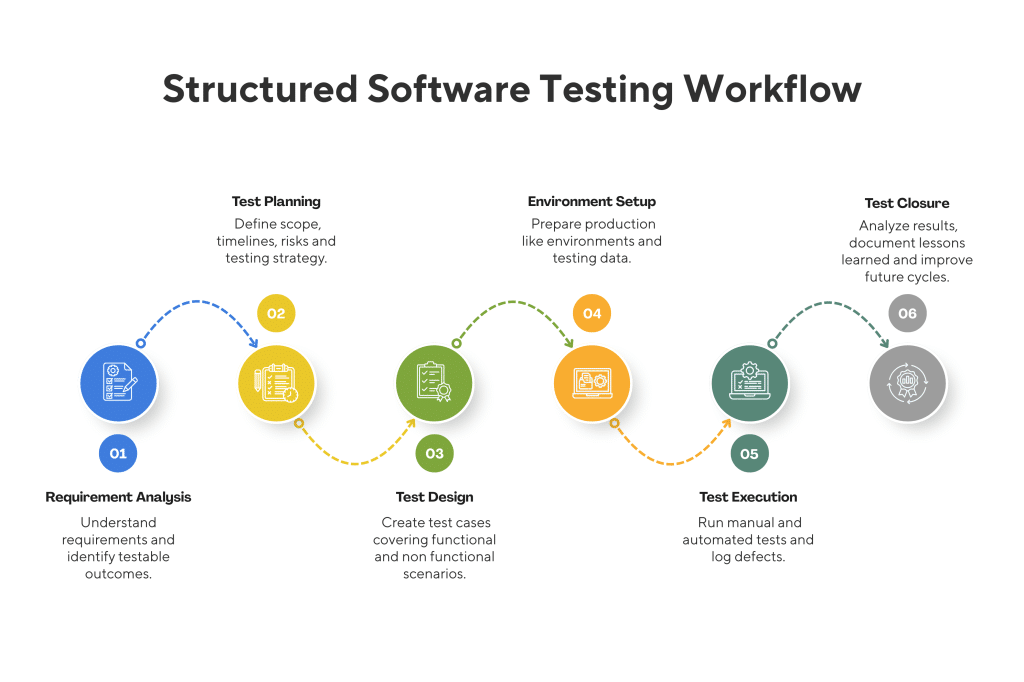
Mature teams cycle through the stages iteratively, achieving defect removal before production.
- Requirement Analysis: Collaborate with product owners to map user stories and specs to testable outcomes, flagging ambiguities or gaps early. This prevents 30% of downstream defects by aligning expectations upfront. Document assumptions and prioritize based on risk, creating a foundation for the entire test management process.
- Test Planning: Outline scope, resources, timelines, entry/exit criteria, and risk contingencies in a formal plan, allocating 20-40% of the development budget to testing for optimal ROI. Include deliverables like coverage goals and stakeholder sign-offs to set clear boundaries for the structured testing process.
- Test Design: Craft detailed test cases covering functional, non-functional (performance, security), and exploratory scenarios. Aim for 80%+ requirements coverage as an industry benchmark. Use techniques like boundary value analysis and equivalence partitioning, while linking cases bidirectionally to requirements for traceability.
- Environment Setup: Provision prod-like environments with realistic data, configurations, and dependencies. Such as cloud mocks or containerized stacks. Doing so will help ensure valid, reproducible results. Also, validate setups via smoke tests to catch infrastructure issues before full execution, minimizing false negatives in your quality assurance testing process.
- Execution: Run a mix of manual (for usability/exploratory) and automated (for regression/smoke) tests. Log defects immediately with severity, steps to reproduce, and screenshots. Parallelize across environments for speed, targeting 95%+ pass rates, and trigger retests on fixes to maintain pipeline flow.
- Closure: Evaluate overall coverage metrics, compile reports on escapes and lessons learned, and archive artifacts for audits or future reference. Conduct retrospectives to feed improvements into the next cycle, closing the loop on your software testing strategy.
Building a Repeatable QA Testing Process for Teams
Repeatability in a QA testing workflow demands treating the process as a living framework: co-create it with the team in a kickoff workshop. Then, refine through quarterly retrospectives.
Use version-controlled templates in Kualitee for plans, cases, and reports to enforce consistency across sprints without constant reinvention. This approach has delivered 40-60% faster delivery in real-world Agile teams by minimizing variance and maximizing reuse.
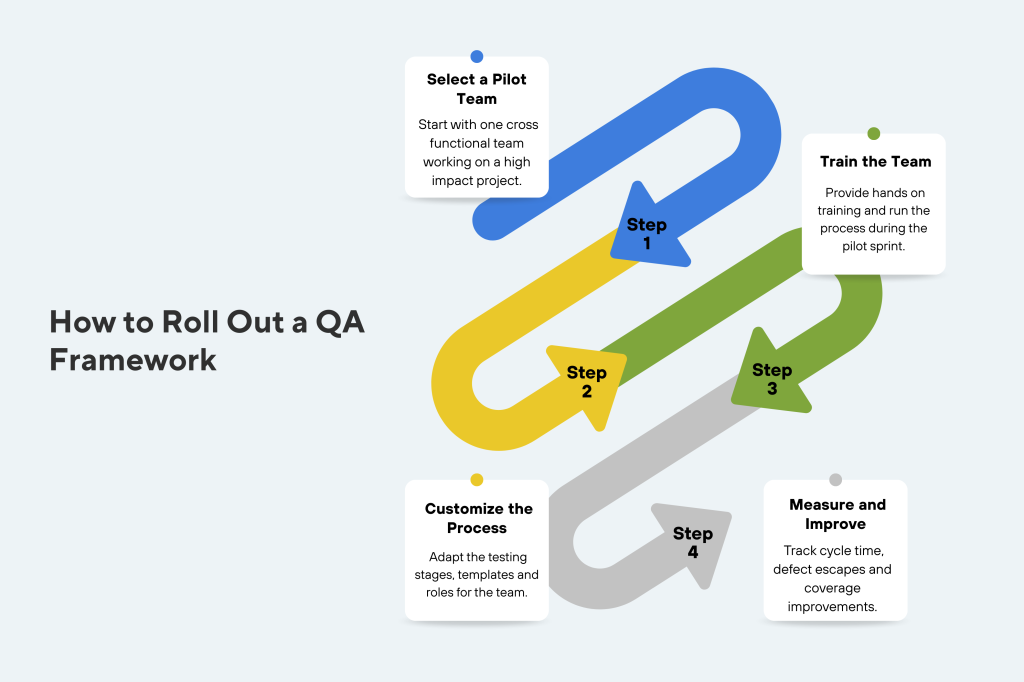
Step-by-Step Rollout for Success
Pilot strategically to generate quick wins and team buy-in.
- Select a Pilot Squad: Choose one cross-functional team handling a high-impact project, like a user-facing feature overhaul. Establish baselines upfront: log current cycle time from planning to sign-off, defect escape rate, and manual testing hours using basic dashboards in Kualitee or Jira.
- Customize and Document: Tailor the core stages – Requirement analysis through closure – to the squad’s context with embedded checklists (e.g., “Verify 80% coverage”) and RACI matrices for clear ownership.
- Train Hands-On: Deliver 2-hour interactive sessions mixing rationale (e.g., traceability’s role in audits) with live exercises. Like building test cases directly in the tool. Also, pair juniors with seniors for the pilot sprint to build confidence fast.
- Measure and Iterate: After the pilot sprint, quantify improvements. Target 20% shorter cycles initially. Publicize successes in team meetings, such as “Structured design caught 15 pre-prod defects,” to drive adoption.
Ready to bring structure and visibility to your testing process?
Sign up for Kualitee and start organizing your QA workflows today.
Pro Tips for Ironclad Repeatability
These field-tested tactics lock in a structured testing process amid real pressures.
- Enforce Peer Reviews as Gates: Require a second reviewer’s approval before execution. Treat test artifacts like code with Git pull requests. This uncovers 25% more issues early and distributes knowledge.
- Automate the Fundamentals: Prioritize smoke and regression suites for your top 70% of critical paths, hooking them into CI/CD pipelines (e.g., Jenkins or GitHub Actions) to trigger on every pull request. This reclaims 50% of manual effort for higher-value exploratory testing.
- Mandate Traceability Rules: Link every test case bidirectionally to requirements and defects, tagging by epic or risk level for easy reuse. Across multiple projects, this reuses 60% of cases, cutting design time significantly.
- Institute Weekly Syncs and SLAs: Hold 15-minute standups to surface blockers like environment delays. Set firm SLAs: triage defects in 4 hours, resolve high-severity ones in 24 hours.
- Build Audit Cadence: Every two weeks, audit a 10% sample of test runs for adherence. Dashboards that flag deviations, like coverage dropping below 80%, keep the QA testing workflow on track.
Once the pilot proves value, roll out team-wide via a shared central repository. Counter pushback by demonstrating personally on your own tests. Monthly metrics reviews adapt the process to changes, such as new integrations, while preserving core discipline.
This method transforms scattered efforts into a scalable quality engine, accelerating releases without sacrificing reliability. Pair it with Kualitee’s AI-driven case generation and execution tracking for seamless implementation across pipelines.
Integrating Testing into Agile and DevOps Pipelines
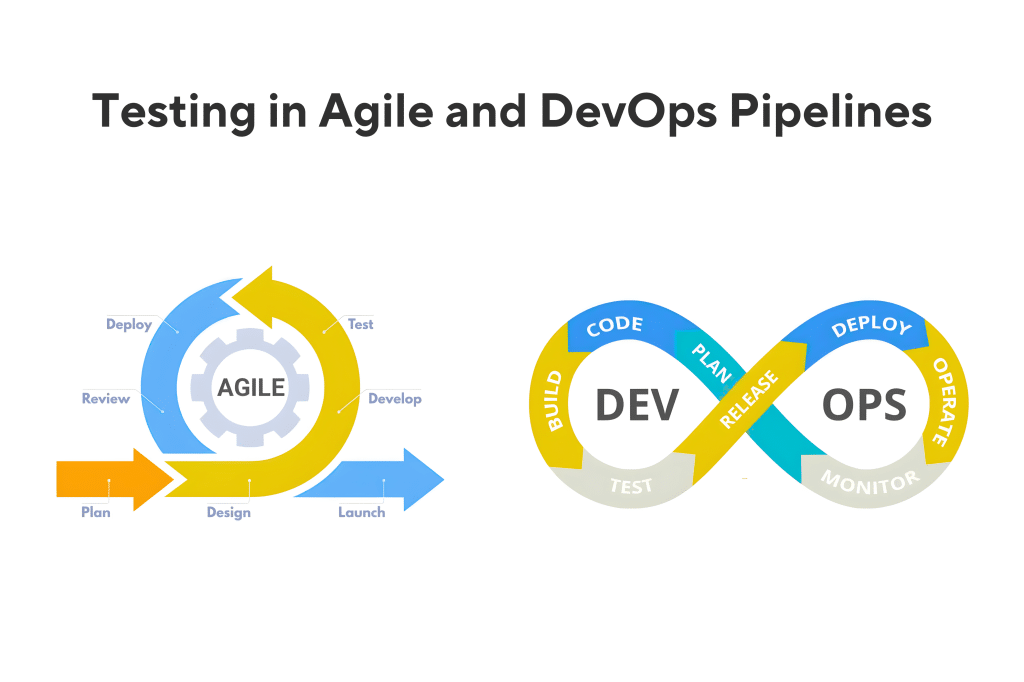
In Agile, weave testing into every sprint with “shift-left” practices. Consequently, QA will join grooming sessions to spot testable stories early. Then, you can set up automation that runs on every code commit. This catches issues fast, before they pile up.
No more end-of-sprint crunches. Tests become part of the daily flow.
DevOps takes it further with CI/CD gates. Set rules where builds auto-fail if test coverage dips below 80% or pass rates fall short. This blocks shaky code from production without manual checks.
Structured testing in Agile lifts team throughput by 65%, as productivity metrics show. Fewer defects mean more time for features.
Kualitee allows smooth handoffs by linking tests to Jira tickets and pipelines, so QA, dev, and ops stay in sync.
Additionally, track easy metrics, such as pass rates (aim for 95%), cycle time from commit to done, and escape rates under 5%.
In short sprints, focus on high-risk paths first, run automations in parallel across environments, and use dashboards for real-time visibility.
Real-world tip: Start small. Automate smoke tests in week one, then expand. This keeps your QA testing workflow from bottlenecking pipelines. It also lets agile teams ship reliable code at full speed without sacrificing quality.
Metrics That Improve Testing Discipline
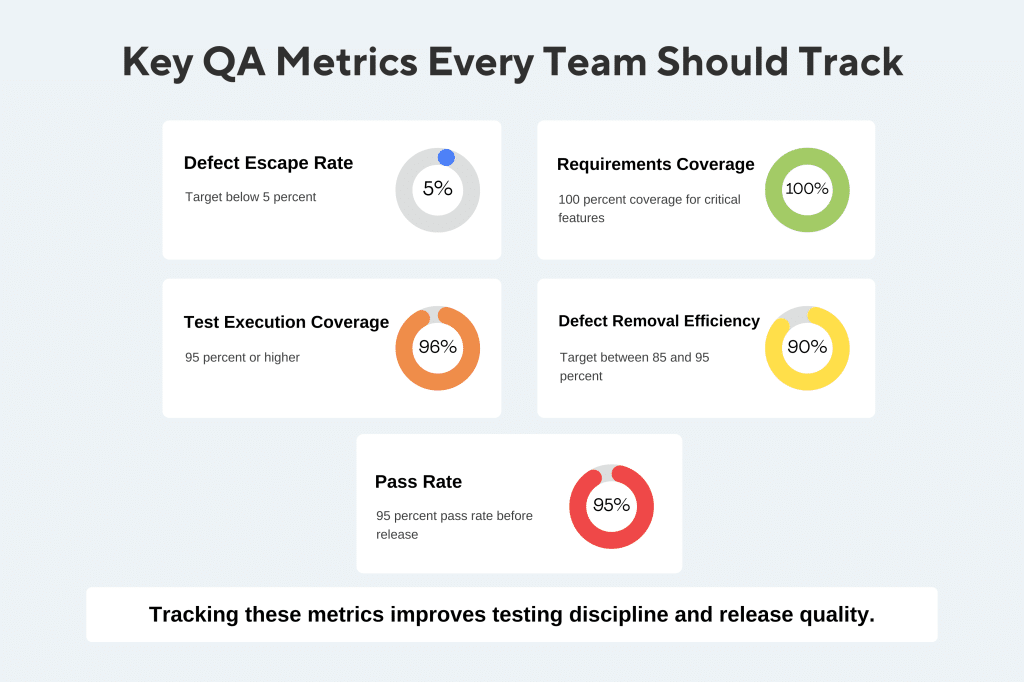
Metrics bring objectivity to your test management process, spotlighting weaknesses and proving QA value to stakeholders.
They guide tweaks, like automating flakier tests, to keep your QA testing workflow sharp and aligned with releases. Pick 4-5 key ones to track weekly via dashboards. Avoid overload by focusing on trends over raw numbers.
| Metric | Industry Benchmark | Impact on QA Workflow |
| Defect Escape Rate | <5% | Signals upstream gaps, drives shift-left. |
| Requirements Coverage | 100% for critical | Proves alignment with business needs. |
| Test Execution Coverage | 95%+ | Ensures no planned tests are skipped. |
| Defect Removal Efficiency (DRE) | 85-95% | Measures pre-release catch rate. |
| Pass Rate | 95%+ | Indicates stability for releases. |
Choosing the right QA platform starts with understanding the cost.
Check Kualitee’s pricing to find the plan that fits your team.
Common Challenges When Implementing a Systematic QA Process
Rolling out a systematic QA process hits real roadblocks, especially in fast-moving teams. Drawing from Reddit threads where QA pros vent about inconsistent processes and tool chaos, here are the top hurdles, plus straightforward fixes to keep your QA testing workflow on track.
1. Inconsistent Testing Across Teams
Users often gripe that teams lean on individual tester skills instead of structured workflows, causing spotty test coverage release-to-release. One sprint nails it, the next skips edges.
Fix it with mandatory templates and peer reviews from day one. Pilot on one team, baseline coverage at 70%, then enforce 80% minimums. This builds a habit without overwhelming everyone.
2. Scattered Documentation and Test Cases
Folks complain docs live in spreadsheets, emails, or wikis. These are hard to find, update, or share. No one knows the full picture, breeding duplicates and misses.
Centralize in one test management tool like Kualitee right away. Migrate the top 50 cases first, tag them by feature, and set “no execution without links” rules. Version control kills overwrite nightmares.
3. Rushed Testing in Short Agile Sprints
Agile teams rush phases as sprints shrink, squeezing regressions and leaving QA reactive. Coverage drops, escapes climb.
Shift to risk-based testing: prioritize high-impact paths (80/20 rule) and automate repeats. Run in parallel in CI/CD, which cuts execution time 50%. Track sprint velocity pre/post to show gains.
4. Weak Test Traceability and Visibility
A big pain that many users face is that there are no clear links from requirements to tests to bugs. Stakeholders can’t gauge quality. Releases feel like gambles.
Build bi-directional matrices early to link every case. Use dashboards for real-time pass/fail by req. Kualitee’s visuals make gaps obvious, proving coverage for go/no-go calls.
5. Scaling Without Proper Tools
Spreadsheets fail at volume, and multiple tools create silos. Tracking execution or results turns into a hunt.
This is why you need to go unified. Pick Kualitee for all your processes, from AI case gen and integrations to reporting.
Start small, import one project, then train. Teams see way less chaos once centralized.
AI is changing how teams design and manage test cases. See how Hootie AI inside Kualitee helps accelerate modern QA workflows.
Closing Thoughts
A systematic testing process does not happen overnight. It develops through clear structure, shared discipline and consistent improvement across teams.
When testing moves from scattered efforts to a defined workflow, quality becomes predictable instead of reactive. Teams gain visibility into coverage, defects are caught earlier, and releases move forward with confidence.
The key is to treat testing as a core part of the product lifecycle, not a final checkpoint before deployment. Risk prioritization, traceability, automation, and data-driven decisions help teams build a process that scales as the product grows.
Start small. Pilot the framework with one team, measure improvements, and refine the approach based on real results. Over time, a structured testing process becomes a natural part of how teams work.
Frequently Asked Questions (FAQs)
Q1) What is a systematic testing process?
A repeatable QA framework with defined stages, traceability from requirements to defects, and metrics like coverage and escapes. It ensures consistent quality across releases, scaling beyond ad hoc testing.
Q2) Why is a structured testing process important in software development?
It keeps defect escapes under 5%, cuts post-release fix costs up to 100x, and builds stakeholder confidence in fast Agile cycles.
Q3) What are the key stages of the software testing process?
Requirement analysis, test planning, design, environment setup, execution, and closure with reports and retrospectives.
Q4) How can teams standardize testing workflows?
Use templates, central tools for storage, peer reviews, and metrics-driven retros to enforce consistency across teams.
Q5) Which tool helps manage a structured testing process?
Kualitee provides test libraries, AI case gen, traceability matrices, and dashboards for smooth Agile execution.