




Traditional QA workflows remain shackled by human coordination. They create friction in today’s rapid development environments.
Multi-agent testing deploys a symphony of collaborative AI agents to handle the full QA lifecycle autonomously.
For this reason, we made sure Hootie serves as the evolutionary layer over conventional tools. Let’s talk more.

Key Takeaways
- Multi-agent testing significantly improves testing efficiency by speeding up testing cycles by 40%. It allows teams to release software faster and with fewer defects.
- Despite advancements in automation, 82% of testers still rely on manual testing, which contributes to higher defect escape rates and inefficiencies. This is the case especially in fast-paced, agile development environments.
- The cost of fixing a bug during testing ranges from $750 to $3,750. But if the issue makes it to production, it can escalate to $1,500 to $7,500 or more. This highlights the importance of early detection to save on costs.
- The AI testing market is rapidly growing, with projections indicating it will increase from $1.9 billion in 2023 to $10.6 billion by 2033. This reflects the growing demand for AI-driven solutions to address testing challenges.
- Teams that implement multi-agent testing report returns on investment (ROI) as high as 1500%. That’s because repetitive tasks are automated, which reduces manual work, minimizes errors and accelerates testing processes.
The Problem with Single-Brain QA
There isn’t just one problem with it.
Having said that, the most prominent ones are as follows.
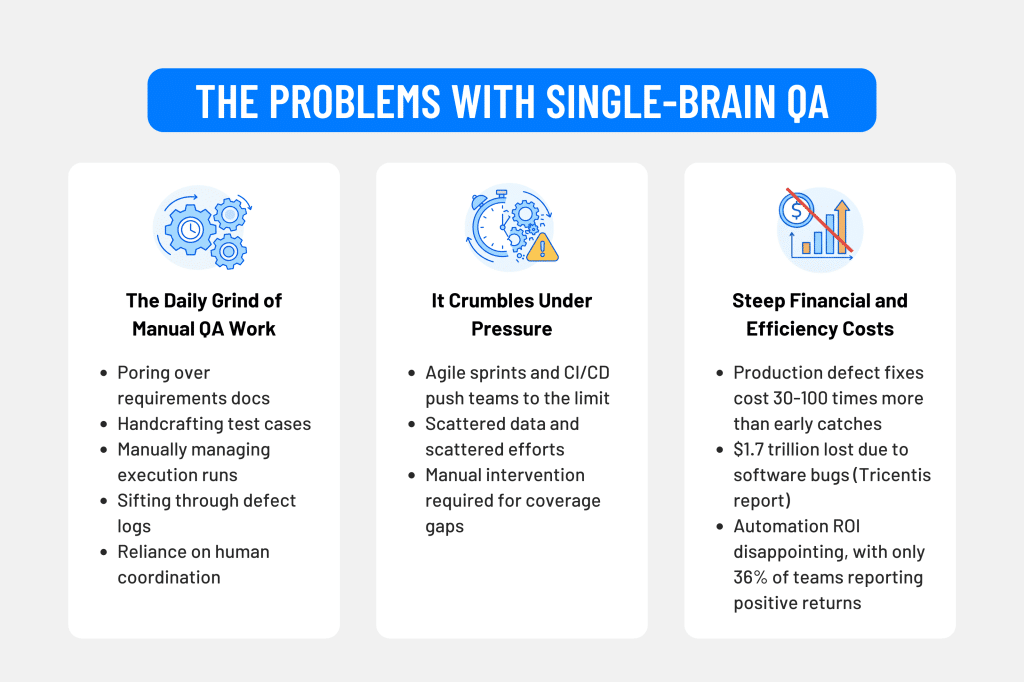
1. The Daily Grind of Manual QA Work
QA engineers and developers face the same grind:
- Poring over requirements docs
- Hand-crafting test cases
- Queuing up execution runs
- Sifting through defect logs
- Crossing fingers for a clean production deploy
Current QA platforms mimic sophisticated task trackers at best. The humans orchestrate planning, dissect results and pivot reactively. They don’t really treat AI as a core system but rather as a bolted-on gimmick.
This is evident in the QA industry report by Katalon, which states 82% of testers still lean on manual testing for daily work. With just 45% automating regression suites to reclaim time.
2. It Crumbles Under Pressure
The single-brain QA setup crumbles under agile sprints, sprawling microservices architecture and relentless CI/CD demands.
Picture your last release: code lands in the pipeline, test spins up. But coverage holes and defect clusters demand your manual intervention, for example, slack pings to devs, Jira updates, and ad-hoc plan tweaks.
AI can generate some test cases, but without proper coordination, it creates scattered data and repeated work.
3. Steep Financial and Efficiency Costs
The fallout? Escalating costs, as production defect fixes balloon to 30-100 times the price of early catches.
Industry data also supports this. It paints a grim picture: software bugs drained $1.7 trillion globally in 217, as per Tricentis. Poor testing contributed heavily to the number. Meanwhile, the AI software testing market surged from $1.9 billion in 2023 to a forecasted $10.6 billion by 2033, growing at 18.7% CAGR. Even after this projection, most stacks haven’t caught up.
Exacerbating this, automation ROI disappoints: only 36% of teams report positive returns, and a mere 21% achieve breakthroughs, largely from disjointed intelligence flows.
Old testing tools keep teams stuck in fire-fighting mode. People have to fix problems that AI cannot handle. Developers lose time dealing with flaky tests. QA teams spend most of their day sorting bugs instead of improving quality. As systems grow more complex, this setup stops scaling. Multi-agent testing breaks this cycle by automating coordination and reducing manual work.
Key Pain Points in Traditional Stacks
- Overreliance on human judgment for risk prioritization
- Siloed AI features lack end-to-end integration
- Ballooning defect escape rates in complex pipelines
Still managing QA with manual coordination and scattered tools? Book a demo with Kualitee and see how it automates execution and defect flow.
Defining Multi-Agent Testing
Multi-agent testing transforms QA into a dynamic team of purpose-built AI agents. It mirrors your human crew’s collaboration, but everything is amplified by tireless automation and real-time adaptation.
Each agent owns a specialized function while intercommunicating through shared contexts, feedback loops and unifies models. The function can be planning coverage, generating cases, executing runs, dissecting defects or scoring risks. Contrast this with monolithic AI, which pumps out rigid, error-prone outputs; multi-agent frameworks employ iterative closed-loop reasoning.
Envision an autonomous QA pit crew that does the following things:
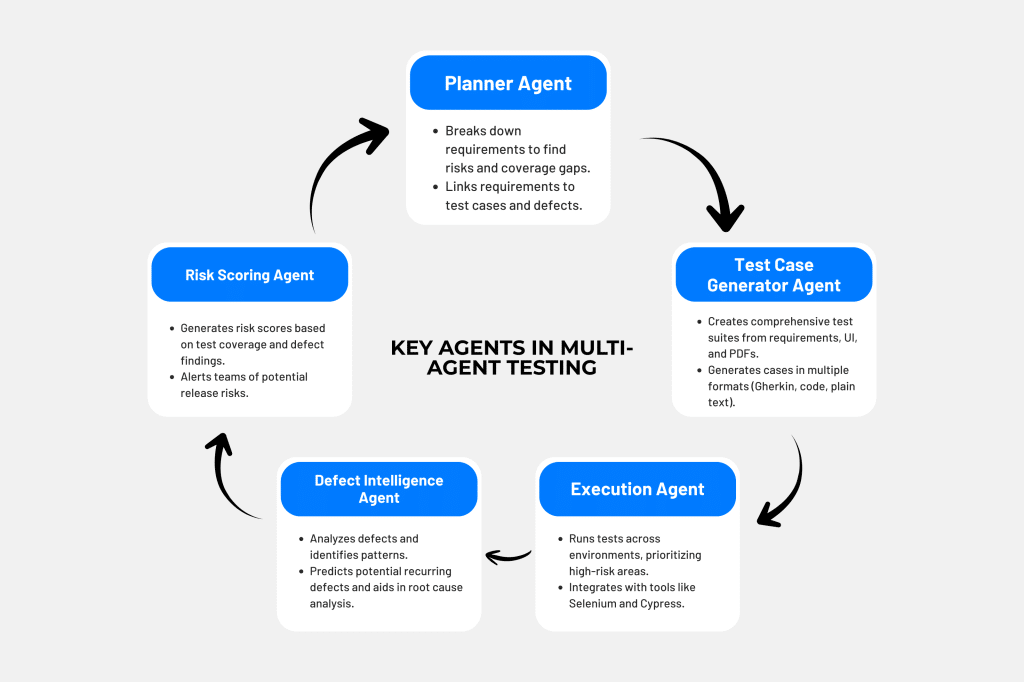
- The planner dissects requirements for vulnerabilities
- Generators craft exhaustive suites
- Executors prioritize, and fire runs
- Analysts unearth patterns
- Scorers gatekeep releases
A shared data backbone enables negotiation and evolution, converging on optional outcomes.
Benchmarks on microservices workloads reveal gamechangers. A 60% drop in invalid tests, 30% coverage uplift and drastic human offload is seen. For developers, it means pristine PR gates without context-switching. QA engineers reclaim bandwidth for innovation over drudgery.
Agents harness LLMs fused with reinforcement learning, self-improving via execution telemetry. Furthermore, the agentic AI boom – from $5.4 billion in 2022 to $7.62 billion in 2025 – signals urgency. 29% of firms are already live, and 44% are queuing up for it. By the end of 2026, 60% of QA teams are projected to embed AI agents.
Main Advantages of Multi-Agent Testing Over Solo AI
- Parallel processing for 5x faster cycles.
- Adaptive self-healing against flakiness.
- Holistic risk foresight spanning SDLC stages.
The 5 Core Agents in Action
At its heart, multi-agent testing thrives on division of labor, where agents synergize for bulletproof coverage. Mapped to Kualitee’s ecosystem, these roles deliver production-grade QA without the overhead.
1. Planner Agent: Mapping Risks from Requirements
This agent reads user stories, requirement documents, designs, and even app screenshots. It breaks them down to find risks, dependencies, and missing test coverage.
Furthermore, the system automatically connects requirements, test cases and defects in both directions. When something changes, it shows what else will be affected. This is similar to how Kualitee creates traceability and impact reports. You no longer need messy Excel files.
Over time, the system also learns from past projects and improves planning. Repeated bugs and missed coverage are reduced through data-driven insights.
Most teams react after issues surface. This approach works before failure happens. In practice, it slashes planning time by 70%, freeing teams for execution.
2. Test Case Generator Agent: Building Comprehensive Suites
Using the planner’s blueprint, this agent creates test cases from different inputs. Such as requirements, UI screens, and PDFs. Coverage includes normal flows, edge cases, and negative scenarios. The output can be in Gherkin, code, or simpler text.
Kualitee’s Hootie does this by converting project artifacts into reusable test cases inside a central repository. It reduces manual test writing by up to 80%.
Additionally, when requirements change, related test cases update automatically, keeping everything aligned during fast iterations.
Developers get ready to use test structures for new features. QA teams discover hidden scenarios without long brainstorming sessions. Integration with version control tracks changes and regenerates only what is needed. In turn, teams move faster without losing control.
Key Generation Strengths
- Multi-format outputs (BDD, scripted).
- Edge-case infusion via adversarial prompting.
- Bidirectional linking to requirements.
Manual test creation limits coverage and consistency at scale. Automated test case generation with Hootie converts requirements into reusable assets.
3. Execution Agent: Prioritizing and Running Tests
Think of the execution agent as the powerhouse of your multi-agent QA team. It runs tests smoothly across cloud or on-prem setups, smartly prioritizing high-risk ones first based on signals from earlier agents like the planner.
Kualitee’s Hootie makes it easy: just input your app URL, credentials, and environment details. It then orchestrates the full test run, tracks progress on a dashboard and auto-logs defects with screenshots and logs for quick triage.
Not just that, Hootie also integrates with tools like Selenium for web automation, Cypress for end-to-end tests, or even APIs for codeless options. It’s perfect for hybrid workflows.
AI tackles common pains like flaky tests through automatic retries, failure analysis and rich captures. Due to this, frustrating wait times are slashed. This aligns with trends as well, where 72.88% of scaling teams push for more automation coverage.
The result? About 40% faster cycles, reliable CI/CD for developers, and more strategic time for QA.
4. Defect Intelligence Agent: Root Cause and Patterns
Picture the intelligence agent as the smart detective of your QA team. After the tests run, it digs into the results:
- Groups similar bugs together
- Figure out what caused them using simple connection maps (like “this error led to that failure”)
- Predicts if they’ll pop up again
Kualitee’s built-in features make this automatic. It grabs bugs as they happen, sorts them by type or seriousness and shows easy trends. It connects with other apps too, spotting bug groups that humans might miss in the chaos.
Key ways it helps:
- Group bugs smartly: Finds patterns like “all login fails trace to one API.”
- Predicts repeats: Warns if a fix might not stick, saving rework.
- Feeds back insights: Tells planners to tweak tests upfront.
The real win? It sends early warnings about bugs that could escape to production, turning messy data into clear alerts you can act on.
Money talks here: fixing a bug during testing costs $750-$3,750, but in production? That’s $1,500-$7,500 or more. Plus, it shares these insights back with earlier agents, like the planner or generator, to make future tests smarter and close the loop.
No more guessing games. Just faster, cheaper fixes.
5. Risk Scoring Agent: Release Readiness Alerts
The risk scoring agent acts as the final referee for your QA process. It gathers all the info from the other agents (like coverage, bugs found, weak spots) and crunches it into easy-to-read risk scores for each build or feature. If something looks shaky, it lights up with a warning. Your team instantly knows to fix it before pushing to production.
Kualitee’s dashboards keep it super simple and visual. You get:
- A quick health overview of the whole project (green, yellow, red).
- Charts showing bug severity breakdowns (e.g., how many critical ones vs. minor).
- Prioritized lists of fixes needed right away (remediation queues).
No more hunting through reports. It’s all on one screen for fast team huddles.
What sets it apart is the smart prediction side: it forecasts the chance of bugs slipping through (“escape risks”). This powers clear go/no-go decisions without relying on gut feelings. Data-driven rules can even auto-block deploys if risks spike, preventing bad releases that could crash your app or upset users.
Reliable releases depend on measurable risk visibility. Risk-based testing dashboards in Kualitee translate coverage and defects into clear release signals.
Why Your Current QA Stack Falls Short
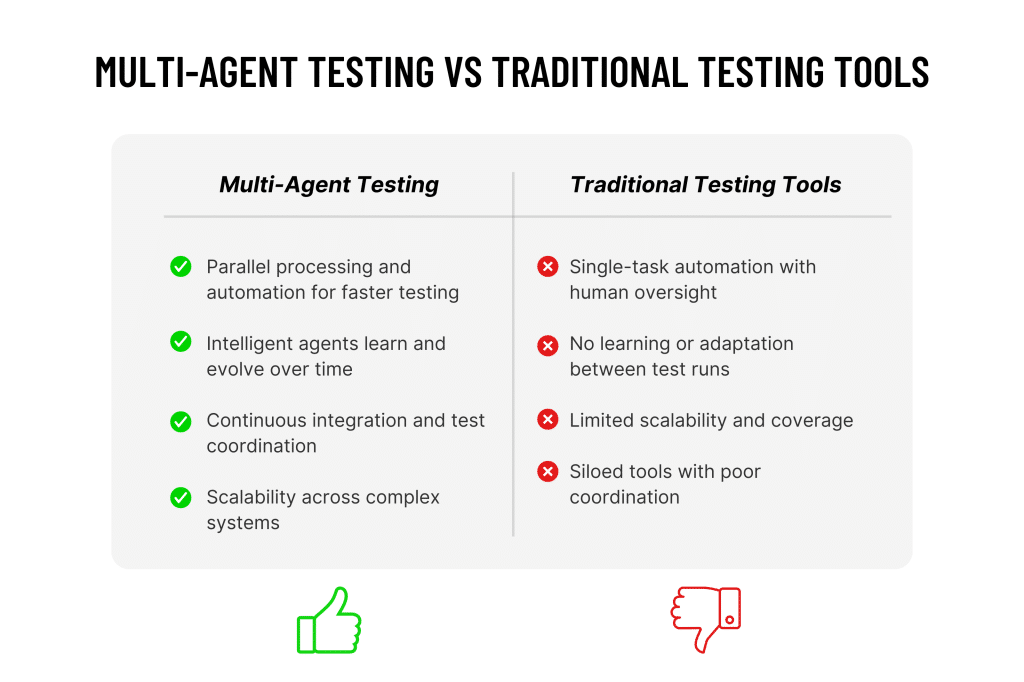
Most older QA tools are good at one or two things. Like running tests or tracking bugs. However, they fall flat when it comes to working together as a team.
There’s no real conversation between modules, no shared “memory” of past runs, and they just pile up data without making sense of it. You end up doing all the connecting and thinking for yourself, which wastes time.
With built-in predictions, you’re stuck guessing about risks instead of knowing them for sure. Tests run in rigid loops with no learning: a single AI might generate cases, but 60% of them flop without feedback to improve. Data stays locked in separate boxes, giving you a chopped-up view that makes decisions slow and risky.
Gartner says 80% of big companies will use AI testing by 2027, but 42% of those projects fail because of poor setup and integration.
Common Pitfalls in Legacy Tools
Here’s why these stacks can’t keep up:
- Isolated modules create blind spots: Planning doesn’t talk to execution, so coverage gaps slip through.
- No feedback means repeating mistakes: Tests stay dumb without learning from failures.
- Data silos force manual work: You merge reports by hand, losing hours.
- Scaling stops at complexity: Manual tweaks can’t handle big, messy apps.
The bottom line? Basic tools are fine for simple apps. But today’s softwares are more complex and harder to manage. When most testing is still manual, teams waste time and hit limits fast.
The real solution is better teamwork between tools and systems. Not more features. Not more dashboards.
You need a smarter setup that can handle real problems on its own, without engineers and QA constantly stepping in to fix things.
Tangible Business Impact of Multi-Agent Testing
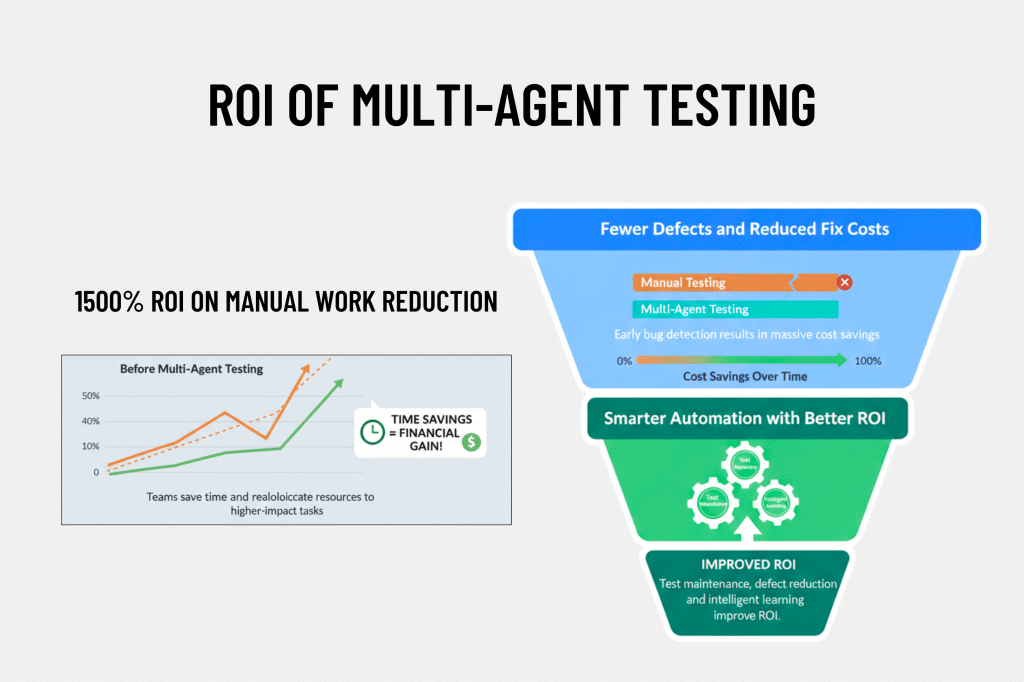
Switching to multi-agent QA (or “agentic QA”) brings real, bottom-line wins you can measure. Test cycles speed up, so your team releases software faster. 67.16% of QA teams are already investing in AI and machine learning to handle bigger workloads without adding headcounts.
Bugs that sneak into production drop sharply, avoiding those nightmare costs where a fix after launch can be up to 100 times pricier than catching it early in testing.
The ROI is huge. Some teams see peaks of 1500% returns by cutting manual work and rework, basically trading low-value tasks for high-impact ones. Audits become a breeze with automatic traceability showing exactly what was tested and why.
All in all, the AI testing market hitting $3.4 billion soon proves that early adopters win big. Think 30% better test coverage and 60% fewer useless or broken tests.
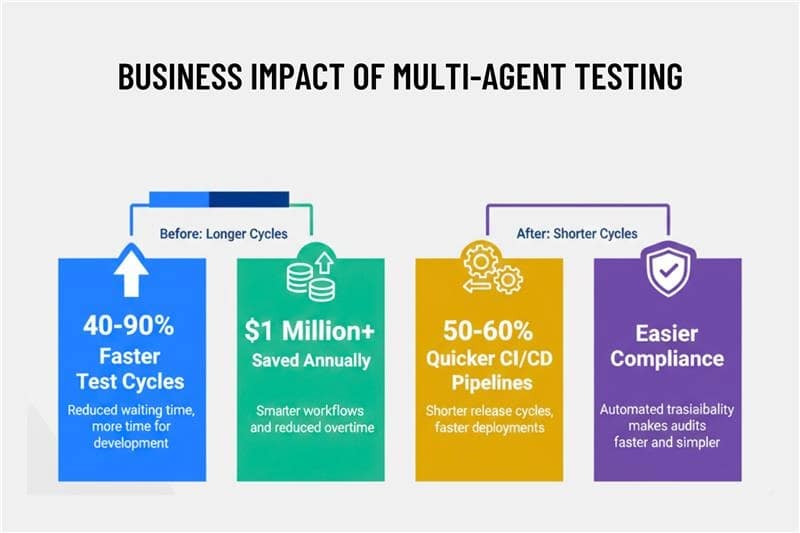
Key Wins for Your Team
Here’s what it looks like in numbers:
- 40-90% faster tests and fewer bugs: Spend less time waiting, more shipping.
- $1 million+ saved yearly: From smarter workflows and less overtime.
- 50-60% quicker CI/Cd pipelines: Green lights come faster, no delays.
- Easier compliance: Auto-reports and trails make audits painless.
In short, it’s not just “cool tech.” It’s faster releases, happier teams, lower costs and safer software that keeps customers smiling.
Conclusion and Next Steps
The QA world has outgrown basic automation tools that work alone. You need a smart, team-like system that can enable multi-agent coordination. And that builds tough, reliable pipelines to handle fast changes and complex apps without breaking.
Kualitee, supercharged by Hootie, is leading this change by bringing all those AI agents together in one place.
It’s quite simple: stop firefighting bugs and delays. Get coordinated intelligence that plans, as well as tests, fixes and scores risks automatically. So, your releases are smoother and safer.
Ready to upgrade your QA stack? Jump into Kualitee’s free trial today.
Frequently Asked Questions (FAQs)
Q1) How does multi-agent testing support continuous testing in CI CD pipelines?
Multi-agent testing automates planning, execution and analysis inside CI/CD. Agents adjust coverage, rerun failed tests, and flag risks in real time. This keeps pipelines fast and stable without manual coordination.
Q2) Can multi-agent testing improve test automation ROI for growing QA teams?
Yes. Agents reduce test maintenance, fix flaky scripts and reuse past data. Teams spend less time managing automation and more time improving quality, which increases ROI.
Q3) How does multi-agent testing help with software test management and traceability?
It automatically links requirements, tests, defects, and results. When changes happen, related items update instantly. This improves visibility and removes manual tracking.
Q4) Is multi-agent testing useful for large-scale enterprise QA and complex systems?
Yes. It scales across teams, tools, and environments. Agents coordinate testing, prioritize risks and centralize insights. This makes enterprise QA faster and more reliable.