


img

Efficient Built-in Defect Management

Get Seamless Workflow Between Defect and Test Management
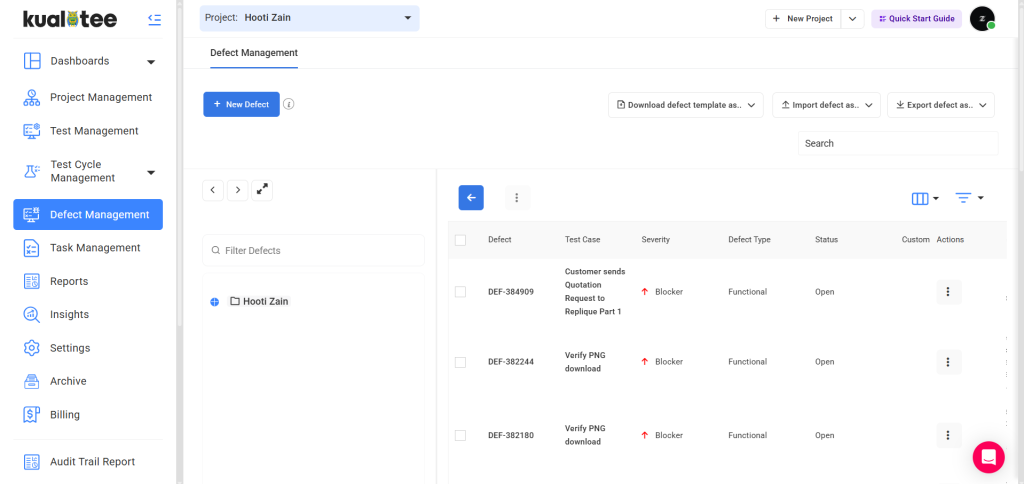
Kualitee’s built-in defect management software removes the wall between finding a bug and tracking it to resolution. When a test case fails, your tester logs the defect directly from that step, with the test context, environment, and expected result already attached. No copy-pasting into a separate system. No information is lost in the handoff to developers.

Most QA teams juggling separate defect tracking tools end up with two sources of truth that never quite match.

Kualitee keeps everything in one place: test cases, executions, and defects, all linked. Your software defect management workflow runs inside the same platform your team already uses for planning and execution, so nothing falls through the cracks between tools.

  • Log defects directly from a failed test case: step number, expected result, and actual result captured automatically.
  • Assign, prioritize, and track every bug through to resolution without leaving Kualitee.
  • One of the few defect tracking tools in software testing that links each bug back to the exact test case that found it.
  • Track defect trends across builds and releases to identify recurring failures before they reach production.

banner
FAQs
  • What is built-in defect management?
    Built-in defect management means defect tracking is part of the same platform as test case management — not a separate tool that requires integration. When a test fails in Kualitee, creating a linked defect takes one click; the defect automatically includes the failing test case, environment, and reproduction steps. This eliminates the "copy screenshot to Jira" workflow that adds 3-5 minutes per defect for QA engineers.
  • Why choose an integrated test + defect tool over Jira plus Zephyr?
    Integrated tools like Kualitee eliminate the sync friction between test management and defect tracking. In Jira + Zephyr setups, test case data lives in Zephyr while defects live in Jira — reporting across both requires custom dashboards. Kualitee unifies both in one platform with reports covering test coverage and defect trends together. Cost saving is also material: Kualitee $12/user/month vs. Jira ($8) + Zephyr Scale ($10) = $18/user/month.
  • Can I still sync Kualitee defects to Jira for developer workflow?
    Yes. Kualitee's built-in defect management is compatible with Jira sync — QA teams work in Kualitee while developers see linked defects in Jira via two-way integration. The best-of-both-worlds pattern: QA logs defects in Kualitee (linked to failing test case, richer context), the defect syncs to Jira for developer visibility, status updates flow both ways. No manual double-entry required.
  • What defect data does Kualitee capture automatically?
    Kualitee automatically captures: (1) failing test case ID and step where failure occurred; (2) environment configuration (browser, OS, device, backend version); (3) screenshot at time of failure; (4) reproduction steps from the test case; (5) tester identity and timestamp; (6) linked requirement or user story. For automated tests, it additionally captures stack traces, network logs, and — for Playwright — full trace viewer output.
  • Does built-in defect management include SLA tracking?
    Yes. Kualitee tracks defect resolution time against configurable SLAs by severity (Critical, High, Medium, Low). Reports show defects breaching SLA, aging distribution, and mean time to fix by team. SLA rules can be customized per project — a payments team might require Critical defects fixed within 4 hours while a marketing site team accepts 48 hours. Notifications trigger when a defect approaches SLA breach.