



Your QA lives in Slack. But your build is elsewhere.
The issue here is that when you create a test run, find that a build is broken, or a defect is found, you need to check Slack along with the testing tool that you’re using, Jira, the bug tracker, and the CI/CD platforms. Doing all this makes you lose your flow state.
A good Slack test management tool is not a tool that pushes all your tests to Slack, but a tool that ensures the right notifications go to the right Slack channel.
So what actually makes a tool good here?
Almost every QA tool claims “Slack support.” That claim alone means little. What matters is the combination of:
- The quality of the test management
- How good the Slack integration actually is
And “Slack integration” is not one thing. It comes in three very different forms:
- Native: The vendor manages a direct Slack connection.
- Webhook-based: Your tool triggers a Slack webhook you create.
- Third-party: Middleware such as Zapier, Zoho Flow, or Automate.io sits in between.
These forms are not all the same. They differ in how they are installed, their maintenance needs, and what features they provide.
We have classified multiple tools below, allowing you to answer the crucial question: Which tool is suitable for pushing my testing processes to Slack?
Best Slack Test Management Software at a Glance
| Tool | Best for | Slack integration | Test management | Automation | Starting price |
| Kualitee | All-in-one QA teams | Native (one-way) | Yes | Yes | Free / $12 user/month |
| Qase | Modern QA & DevOps | Native | Yes | Yes | Free / $35 user/month |
| PractiTest | Enterprise visibility | Native | Yes | Yes | $49 user / month |
| TestMonitor | Test activity tracking | Native | Yes | Via integrations | $11 / 3 users/month |
| TestCollab | Collaborative QA | Native | Yes | Yes | From $29 user / month |
| Katalon TestOps | Automation teams | Native (webhook URL) | Yes | Yes | From $84 / seat / month |
| Xray | Jira-centric teams | Via Jira/webhooks | Yes | Yes | From $10 / month (10 users) |
| Testmo | Unified testing | Via webhooks | Yes | Yes | From $59 / month (5 users) |
| TestLodge | Lightweight QA | Third-party (Zapier/Zoho) | Yes | Via integrations | From $34 / month |
| TestMu AI | Browser/device testing | Native (issue sharing) | Partial | Yes | From $17 / month |
Best Slack Test Management Software: Detailed
1. Kualitee: Best Overall Slack Test Management Software
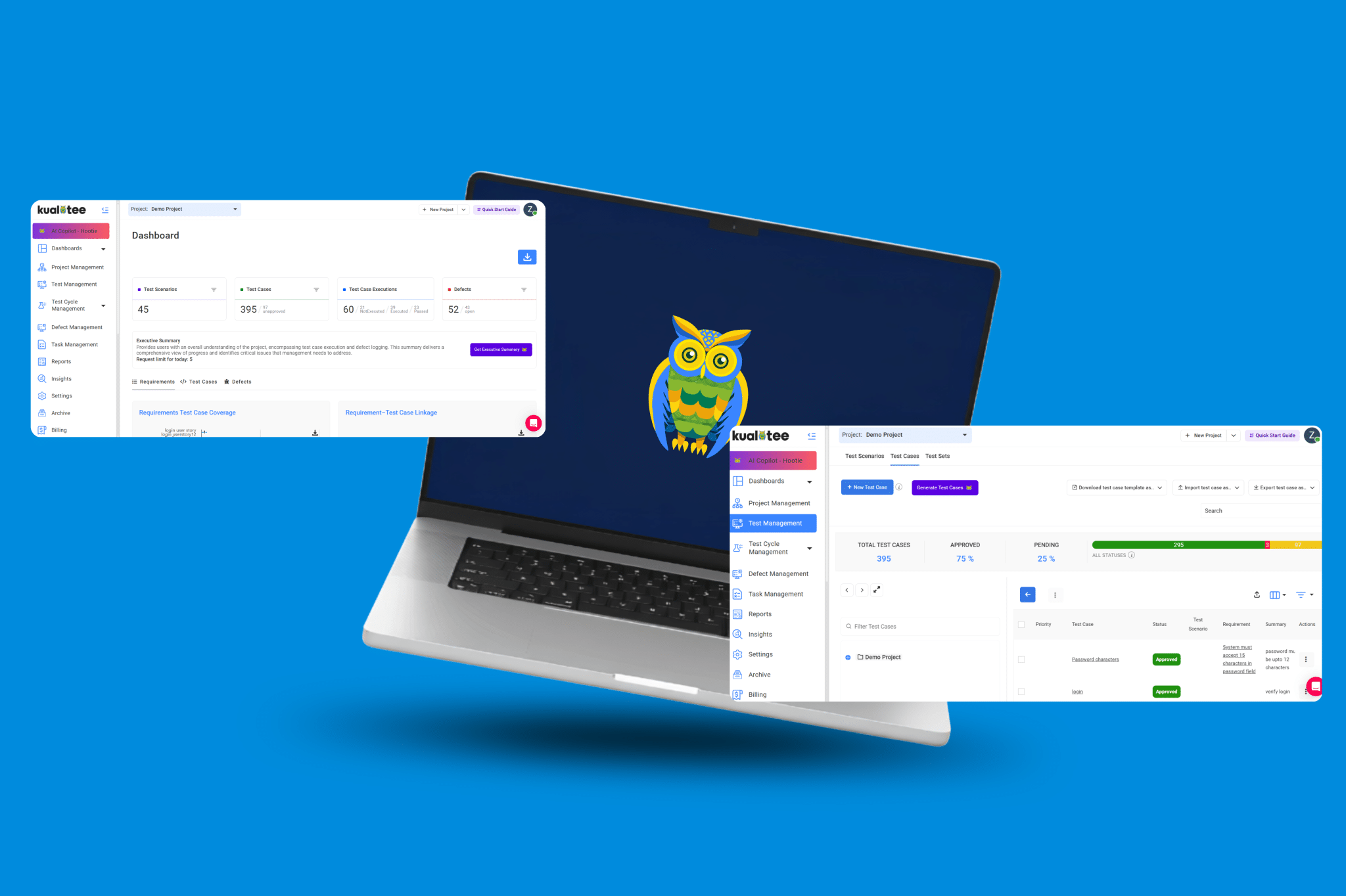
Kualitee is a test management solution that provides end-to-end support for planning, testing, defects, requirements, and reports, all integrated into one solution along with a great Slack integration.
Key features:
- Hootie AI can generate tests from requirements, a user story, or even a UI screenshot, as well as defect impact analysis and prioritisation.
- Native defect management comparable to dedicated bug trackers.
- Requirement traceability, release management, custom workflows and dashboards built in.
- Automation (Selenium, Cypress, Playwright, Jenkins, 2-way Jira sync).
- Cloud or on-premise deployment; mobile apps (iOS and Android); SDK.
Slack integration: Native
- One-way, set up at the project level.
- Pushes updates about Kualitee issues into a Slack channel automatically.
- Supports custom field mapping, so the right fields land in Slack.
- Needs admin access on both tools to set up.
Best for: QA teams that want one full-featured platform and use Slack to keep everyone posted.
| Pros | Cons |
| Full test and defect management | Slack is one-way (Kualitee to Slack) |
| Native Slack with field mapping | You can’t run tests from Slack |
| Free-forever plan | |
| Cloud and on-premise |
Pricing: Free Growth plan, then starting at about $12/user/month.
2. Qase
Qase is a modern, cloud test management tool. It has a clean interface, strong CI/CD ties, and one of the deepest native Slack integrations on this list.
Key features:
- Test cases, test runs, test planning, and defect management.
- AIDEN AI creates manual tests in Confluence, Jira, GitHub, and Notion, then automatically converts them to Playwright, Cypress, and Selenium.
- 35+ integrations, automation aggregation, and requirements traceability.
Slack integration: Native, in real time, and highly configurable.
- Send everything to a single channel or send individual events/projects to separate channels.
- Notify on test cases, test runs, plans, defects, milestones, suites, and reviews.
- Notifies on every event from creation till its deletion.
Best for: Modern engineering and DevOps teams that want entry-level Slack control.
Pros: Native, real-time, configurable notifications · Per-event and per-project routing · Strong automation ties
Cons: AI runs on credits that add cost · Some read-only seats are billed separately
Pricing: Free tier, then from around $35 per user/month annually. Verify before publishing.
Full Kualitee vs Qase comparison →
3. PractiTest
PractiTest is an enterprise test management platform built around traceability. Its native Slack integration keeps large, distributed QA teams aligned.
Key features:
- Modules for requirements, test library, sets and runs, issues, and milestones.
- End-to-end traceability across all of them.
- SmartFox AI with no per-use credit system.
Slack integration: Native and configurable.
- Posts updates when tests, issues, or requirements are created, updated, run, or fail.
- Route different events to different channels.
- Read testing status straight from the Slack feed.
Best for: Large or regulated QA teams that need shared visibility and audit trails.
Pros: Deep traceability · Native, configurable Slack notifications · AI with no credit metering
Cons: Cloud-only · Higher entry price · More than a small team needs
Pricing: From around $49 per user/month annually. Verify before publishing.
Full Kualitee vs PractiTest comparison →
4. TestMonitor
TestMonitor is a clean, structured platform for UAT and business testing. Its native Slack integration is one of the most polished for plain activity updates.
Key features:
- Test cases, milestones, runs, results, requirements, and risks.
- In-built issue tracking and reporting.
- Easy-to-use UI that is learned quickly by non-technical testers.
Slack integration: Native and pushes notifications for events.
- Link your projects to their own individual Slack channels.
- Notifications when runs are scheduled, milestones are reached, new issues are opened, status is updated, and comments are added.
- Weekly test report sent out every Monday morning.
Best for: Teams that want reliable test activity visibility in Slack, especially UAT.
Pros: Native, per-project channel · Rich event coverage · Weekly summary · Simple UI
Cons: Automation is integration-based, not native execution · No free plan
Pricing: Starter from $11/month for 3 users.
5. TestCollab
TestCollab is a test management platform that supports collaboration. The native integration with Slack revolves around the coordination of events that the teams plan.
Key features:
- Cases, suites, plans, runs, requirements, milestones, and defects.
- QA Copilot generates cases using Jira issues, requirements, and screenshots.
- Integrations with Jira, GitLab, GitHub, Azure DevOps, and CI/CD
Slack integration: Native, activated by the account owner.
- Notifications for selected events.
- Triggered by creation of cases, creation and completion of test plans, and comments on run cases.
Best for: Teams that want collaborative test management with configurable Slack alerts.
Pros: Native, event-level notifications · Strong collaboration and Copilot authoring · Broad integrations
Cons: Notifications are one-way · Owner access needed to configure
Pricing: From around $29 per user/month when billed yearly.
Full Kualitee vs TestCollab comparison →
6. Katalon TestOps
Katalon TestOps is an analytics and orchestration layer of the Katalon platform. It notifies users about test results and defect alerts through Slack.
Key features:
- Test process, automation, analysis, and defect reporting.
- CI/CD pipeline management through Katalon Studio.
- Best fit in the Katalon environment.
Slack integration: Built-in.
- It uses a Slack webhook URL that you have to create and paste in manually; no one-click setup.
- Posts test run and result notifications to a channel.
- Can alert on defect-report activity and updates.
- Supports public and private channels.
Best for: Teams deep in automated testing and the Katalon stack.
Pros: Native alerts for results and defects · Strong automation orchestration · Public and private channels
Cons: Webhook-URL setup, not one-click · Most useful only within Katalon
Pricing: From $84/seat/month. No free tier.
7. Xray
Xray lives inside Jira, not Slack. So if your QA runs in Jira, Xray gives you test management right where your work already happens, and it connects to Slack for notifications and updates so your team stays in the loop without leaving either tool.
Key features:
- Test cases, tests, and testing plans are created as Jira issues.
- Manual, automated, and BDD/Gherkin through Cucumber.
- Full traceability inside Jira.
Slack integration: Xray does not provide a dedicated Slack integration.
- Slack is integrated through Jira automation rules and incoming webhooks.
- Create a Jira automation rule that will fire a webhook to Slack on a certain change related to tests.
- Very effective if you already use Jira automation.
- More complex to set up and maintain than a native app; requires configuration of Jira
This is a Jira-automation-based workflow.
Best for: Teams that test inside Jira and are fine building Slack flows through automation.
Pros: Testing stays in Jira · Flexible Slack flows via automation · Strong traceability
Cons: No native Slack app · Slack setup needs Jira automation know-how
Pricing: From around $10/month for small Jira teams, often billed on total Jira users. Verify before publishing.
Full Kualitee vs Xray comparison →
8. Testmo
Testmo unifies manual, automated, and exploratory testing. It reaches Slack through webhooks, not a built-in app.
Key features:
- Manual cases, automation reporting, and discovery sessions.
- Reporting is a strong suit.
- Integration with tracking, CI/CD, and automation tools.
Slack integration: Testmo has no native one-click Slack app.
- The webhooks post test results to Slack.
- Can format messages using Slack BlockKit for clean formatting.
- Flexible and good UI, but you configure and maintain it.
Best for: Teams combining manual, automated, and exploratory testing who don’t mind wiring up webhooks.
Pros: Unified testing types · Structured Block Kit messages · Strong reporting
Cons: No native app · Webhook setup required
Pricing: Starts at $59/month for up to 5 users, scaling in seat blocks.
Full Kualitee vs Testmo comparison →
9. TestLodge
TestLodge is a deliberately simple tool for small teams. It’s the clearest case here of Slack support that leans on third-party automation.
Key features:
- Test cases, suites, plans, runs, and reporting.
- Tracker integrations to raise bugs from failed tests.
Slack integration: TestLodge doesn’t offer native Slack integration.
However, it can integrate with Slack through:
- Automation apps, for instance, Zoho Flow or Zapier.
- Automation apps run Slack actions on the events initiated in TestLodge.
Best for: Small teams that want simple test management and are fine routing Slack through an automation tool.
Pros: Simple and easy to learn · Slack possible via Zapier/Zoho Flow
Cons: No native or direct Slack webhook · Slack needs a third-party subscription
Pricing: Flat monthly plans from around $34/month.
10. TestMu AI
TestMu AI (formerly LambdaTest) is a cloud testing platform for cross-browser and device testing. It has a native Slack app for sharing issues, but it leans more toward testing than classic test management.
Key features:
- Cross-browser and real-device testing across thousands of environments.
- Automated and visual testing.
- A Test Manager module for organizing cases.
Slack integration: Native, via OAuth.
- Push issues and bugs from a test session to a person or channel in real time.
- Shared issues carry screenshots and metadata like project, environment, and severity.
The old /screenshot slash command, which used to run screenshot tests from within Slack has been discontinued. The application has since evolved to sharing issues within Slack and not running tests within Slack.
TestMu AI should be considered a testing and automation cloud rather than a comprehensive test management solution. It works perfectly for testing browsers and devices and sharing issues via Slack. For the organization of cases and plans, the mentioned solutions will suit much better.
Best for: Teams focused on browser and device testing that want to push bugs into Slack.
Pros: Native Slack app for real-time issue sharing · Huge browser and device coverage · Screenshots attached
Cons: More automation cloud than test management · Slack screenshot command is gone
Pricing: Starts at $17/month.
Slack Test Management Software Comparison
| Tool | Test management | Defect management | Automation | Slack integration | Best for |
| Kualitee | Full | Native | Native | Native (one-way) | Overall QA |
| Qase | Full | Native | Native | Native | Modern QA |
| PractiTest | Full | Native | Via integration | Native | Enterprise QA |
| TestMonitor | Full | Native | Native | Native | Activity tracking |
| TestCollab | Full | Native | Native | Native | Collaboration |
| Katalon | Full | Via Jira | Native | Native (webhook URL) | Automation |
| Xray | Full | Native | Native | Jira/webhook | Jira teams |
| Testmo | Full | Via tracker | Native | Webhook | Unified testing |
| TestLodge | Full | Via tracker | Via integration | Third-party | SMBs |
| TestMu AI | Partial | Issue sharing | Native | Native (issue sharing) | Browser testing |
How to Choose the Right Test Management Tool for Slack
The right tool depends on two things: how deep your testing needs are, and how your team uses Slack. Here is what to consider.
1. Depth of Test Management
- Can you create and organize test cases?
- Can you build test plans and run them?
- Can you track defects natively, not just through a tracker?
- Can you link requirements for traceability?
A great Slack feed on top of weak test management means limited test management.
2. Slack Integration Depth
Don’t stop at “does it do Slack?” Ask:
- Is it native, webhook-based, or third-party?
- What triggers alerts: just runs, cases, defects, milestones, comments?
- Can you choose channels? Private ones?
- One-way updates, or can you take actions from Slack?
Most of these tools are one-way, which is often all your team needs.
3. Automation Support
If automation matters, check for native execution versus result-syncing: CI/CD hooks, Selenium, Playwright, Cypress, and API access.
4. Reporting
Look for execution reports, defect trends, release readiness, and real-time updates both in the tool and in Slack.
5. Pricing and Scalability
Compare free plans, per-user pricing, team limits, and any AI-credit caps that bump up the price later. A low up-front price with metered AI can cost more than a higher flat rate.
Native vs Webhook vs Third-party: What’s the Difference?
| Native | Webhook-based | Third-party | |
| How it works | Vendor-built direct connection, usually via OAuth | Tool fires events at a Slack webhook URL you create | Middleware (Zapier, Zoho Flow) passes events between the two |
| Setup effort | Low: authorize, pick channels, done | Medium: you create and wire the webhook | High: extra account plus mapping |
| Upkeep | Vendor maintains it | You maintain it | You maintain two connections |
| Reliability | Highest | Good | Adds a failure point |
| Example | Kualitee to Slack | Testmo to a webhook to Slack | TestLodge through Zoho Flow to Slack |
Choose the type based on how much setup your team can take.
Which Slack test management tool should you choose?
| If you need… | Consider |
| Best overall dedicated QA platform | Kualitee |
| Modern QA/DevOps workflow | Qase |
| Enterprise QA management | PractiTest |
| Simple project/test notifications | TestMonitor |
| Collaborative test management | TestCollab |
| Automation-focused testing | Katalon TestOps |
| Jira-native testing | Xray |
| Unified manual + automated testing | Testmo |
| Lightweight test management | TestLodge |
| Browser/device testing | TestMu AI |
Ready to Keep Your QA and Slack in Sync?
Are you looking for a solution that does it all, from testing to managing tests and even integrates with your Slack channel?
Try out Kualitee. It offers full test and defect management, a native project-level Slack integration, and it’s free to try.