



When a ‘bug detected’ alert appears during testing or runtime, it signals a software defect disrupting functionality, performance or security.
Issues in these areas are a bit of a struggle to catch with traditional manual methods. This costs teams exponentially more to fix later in the SDLC.
Considering this, organizations now usually make the reliability and quality of their software products a top priority. They try to make sure that bug detection is done early, and the user experience of their software remains top-notch.
To make things quicker and more efficient, these organizations employ AI and machine learning models.
Moving forward, the bug detection software market, valued at USD 1.5 billion in 2024, is projected to reach USD 4.2 billion by 2033. With a 15.8% CAGR. And driven by AI advancements.
That said, let’s talk more about automated bug detection with machine learning in this article.
Understanding Software Bug Detection
Software bugs are flaws, errors or vulnerabilities that are embedded within the code. These flaws can cause applications to crash or yield incorrect results. Security risks are often introduced due to them as well.
Note that defects significantly impact business outcomes. U.S. companies incurred $607 billion in losses in 2022 alone due to software errors and associated factors, such as customer churn, as per a report by CISQ.
Bug detection involves identifying these issues early. Ideally, during the initial stages of development. That’s because fixing bugs in production can cost up to 100 times more than resolving them during design or coding phases.
The global bug detection software market growth is fueled by increasing complexity in software systems. Along with the rising demand for secure, high-quality digital products across diverse industries such as finance and healthcare.
Traditional manual testing methods, such as code reviews and user feedback, are often insufficient for thorough bug detection due to:
- Their time-intensive nature
- Vulnerability to human error
This leads to issues like incomplete bug reports, ineffective collaboration between developers and testers and prolonged resolution times. These challenges contribute to a significant portion of bugs that are only reported after the software release.
Fortunately, the recent advances in automated bug detection technology, particularly those driven by machine learning (ML) and artificial intelligence (AI), have changed this trend. The ML models analyze vast amounts of historic and real-time code data to extract critical features like syntax patterns and complexity metrics.
These models can identify defects with high precision. They can also recall and achieve F1 scores nearing 0.98, as per the paper on ensemble learning based software defect prediction by Xin Dong and others. The bugs are effectively predicted and classified early in the software lifecycle.
Practical Implementation
The practical implementation of these technologies involves pipelines that:
- Preprocess data
- Train models on labeled bug datasets
- Validate their performance using standard metrics such as ROC curves
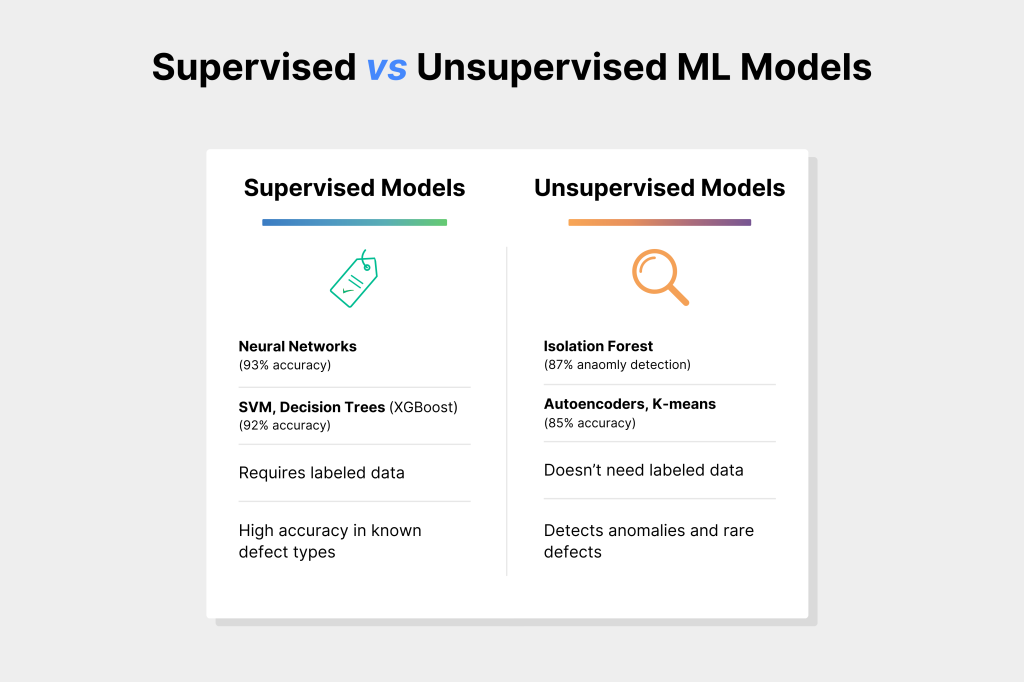
For example, anomaly detection models like Isolation Forests are employed to recognize unusual code patterns without needing prior labels. Similarly, supervised models, such as deep neural networks, excel in classifying known defect types.
Methods and Techniques for Software Bug Identification
Core techniques in software bug detection include code reviews, unit testing and exploratory testing sessions. However, manual approaches often result in incomplete or ambiguous bug reports and collaboration gaps between testers and developers. This delays release cycles.
Machine learning addresses these challenges by making use of feature extraction from multiple sources, which are:
- Code syntax and structure
- Code complexity metrics, such as cyclomatic complexity
- Runtime logs and telemetry data
These features feed into ML models that outperform humans in both speed and accuracy, especially on large datasets.
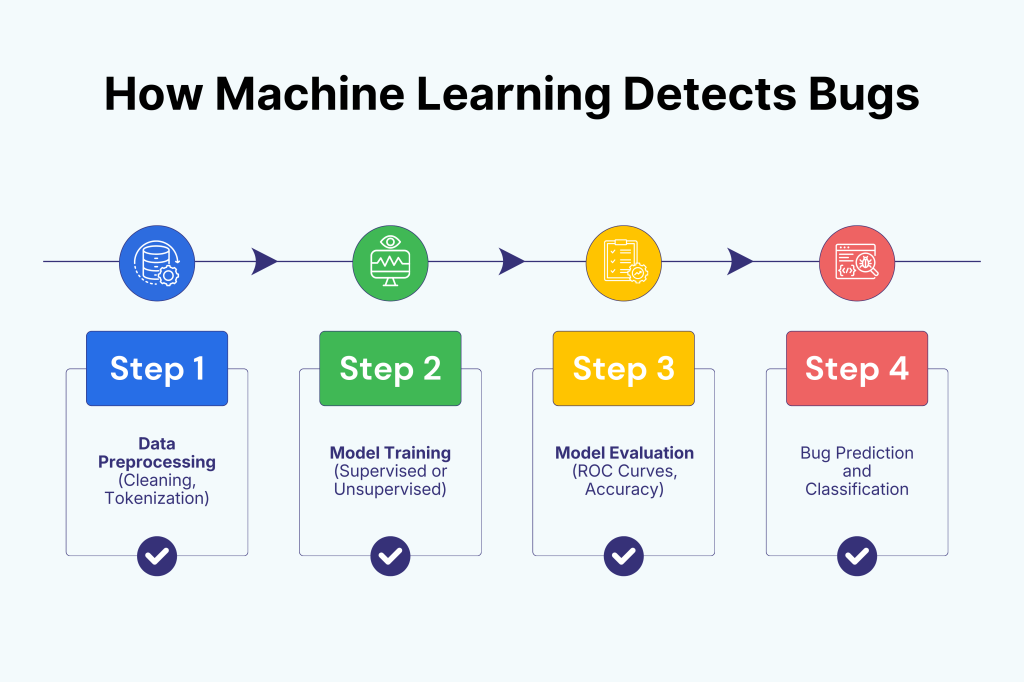
Public datasets from organizations like NASA and Apache provide reproducible benchmarks. Typical machine learning bug detection pipelines include:
- Data preprocessing and tokenization of source code
- Training supervised models on labeled bug and non-bug instances
- Evaluating model performance using metrics like precision, recall, F1-score and ROC curves
Learn more about the test case management platform and how to track these pipeline outputs at scale.
Reported accuracy levels range between 78% and 89% F1 scores across various real-world datasets, demonstrating the reliability of ML-based approaches.
Having said that, here is a simple pseudocode example illustrating anomaly detection with an Isolation Forest model:
| def detect_anomaly(code_features): model = IsolationForest(contamination=0.1) model.fit(code_features) anomalies = model.predict(new_features) # -1 flags potential bugs return anomalies |
This method is particularly useful for discovering rare or previously unknown bugs in unlabeled datasets by identifying outliers that deviate significantly from normal code behavior.
Such ML-integrated workflows help shift bug detection earlier in the development cycle. They enable teams to catch defects sooner, reduce costs and improve software reliability.
Manual vs. Automated Bug Detection: Best Practices and Root Cause Analysis
Manual testing relies on human expertise for code reviews, exploratory sessions and defect reporting. However, it faces limitations like fatigue, along with oversight and inconsistent coverage. It is ideal for creative edge cases yet inefficient for scale.
When it comes to automated ML-driven detection, it uses algorithms trained on historical data for real-time analysis. This process excels in pattern recognition and continuous monitoring while reducing human error. Hybrid approaches combining both yield optimal results: AI handles volume, humans validate nuances.
| Aspect | Manual Detection | Automated (ML-Driven) |
| Time to Detect | Hours to days; 20% developer time wasted | Minutes; real-time CI/CD alerts, 50-70% faster |
| Cost Impact | 6-30x higher post-release; up to 100x in production | Early fixes save 100x; proactive prevention |
| Accuracy | Prone to human error, non-reproducible bugs | 50-89% prediction; 90-95% rates, 60% fewer false positives |
| Scalability | Limited for complex/large apps | Handles high-dimensional data, massive volumes |
| Coverage | Exploratory depth, but gaps in repetition | Extensive auto-test generation, continuous monitoring |
| Best For | Usability, complex scenarios | Regression, pattern-based defects |
Using AI and Modern Test Automation Strategies in Software QA
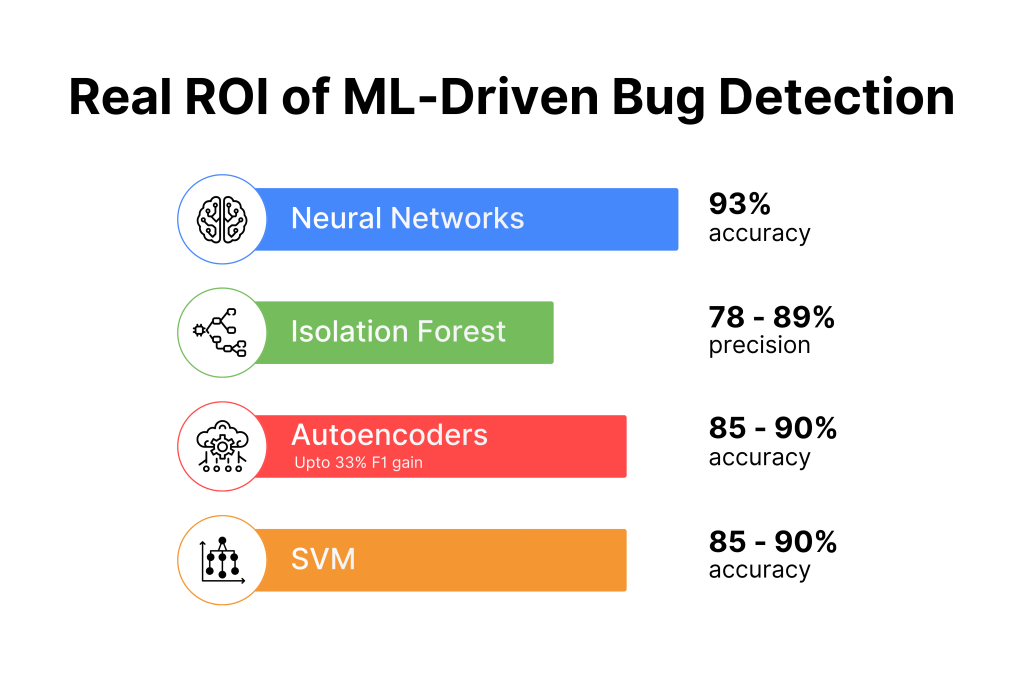
AI-driven bug detection has made software QA easier. But how? Well, the answer is simple: By predicting defects early through supervised and unsupervised models and achieving up to 93% accuracy across datasets.
According to the paper “Hybrid Deep Learning Approach for Automating App Review,” published by Nahed Alsaleh, supervised techniques like neural networks and SVMs deliver 71% AUC gains over baselines with labeled data. On the other hand, unsupervised autoencoders and Isolation Forests identify outliers without labels. This lets them reach F1-scores of 0.98 in real-world pipelines, as we mentioned earlier.
Furthermore, integrating into CI/CD with GitHub Actions that trigger Kualitee’s Hootie AI on commit flags bug breach detection risks before merging. This reduces escape rates massively.
Research on AI-driven innovations in software engineering by Mamdouh Alenezi shows that teams adopting the aforementioned strategies report 35% faster bug resolution. Along with 50% fewer production incidents since ML analyzes code syntax, logs and metrics for predictive insights.
Users often say, “Can AI catch bugs before they bite?”— Yes. Through Kualitee’s analytics that prioritize severity and automate triage.
That said, refer to the table below for the key machine learning techniques for software bug detection.
| Technique | Strengths | Weaknesses | Accuracy/F1 | Use Case | Example Tools |
| Supervised (Neural Networks) | Handles complex patterns; 83-93% accuracy | Requires labeled data; compute-intensive | 93% avg; 0.98 F1 | Regression testing, classification | TensorFlow, Kualitee Hootie AI |
| Supervised (SVM) | Effective in high-dimensional spaces; robust to noise | Less effective on cluttered data | 85-90% | Bug severity prediction | Scikit-learn |
| Supervised (Decision Trees/XGBoost) | Interpretable; fast training; top performer on bug datasets | Prone to overfitting without tuning | 90-95%; best RMSE | Feature-based prioritization | XGBoost, WEKA |
| Unsupervised (Isolation Forest) | No labels needed; detects rare anomalies quickly | Hyperparameter sensitive | 78-89% precision | Log anomaly hunting | Scikit-learn |
| Unsupervised (Autoencoders) | Spots deviations in code behavior; scalable | Needs large datasets for training | Up to 33% F1 gain | Unlabeled outlier detection | Keras |
| Unsupervised (K-means/DBSCAN) | Groups similar defects; handles noise (DBSCAN) | K-means needs cluster count | 80-85% clustering accuracy | Exploratory defect grouping | Scikit-learn |
Benefits of Automated Bug Detection with Machine Learning
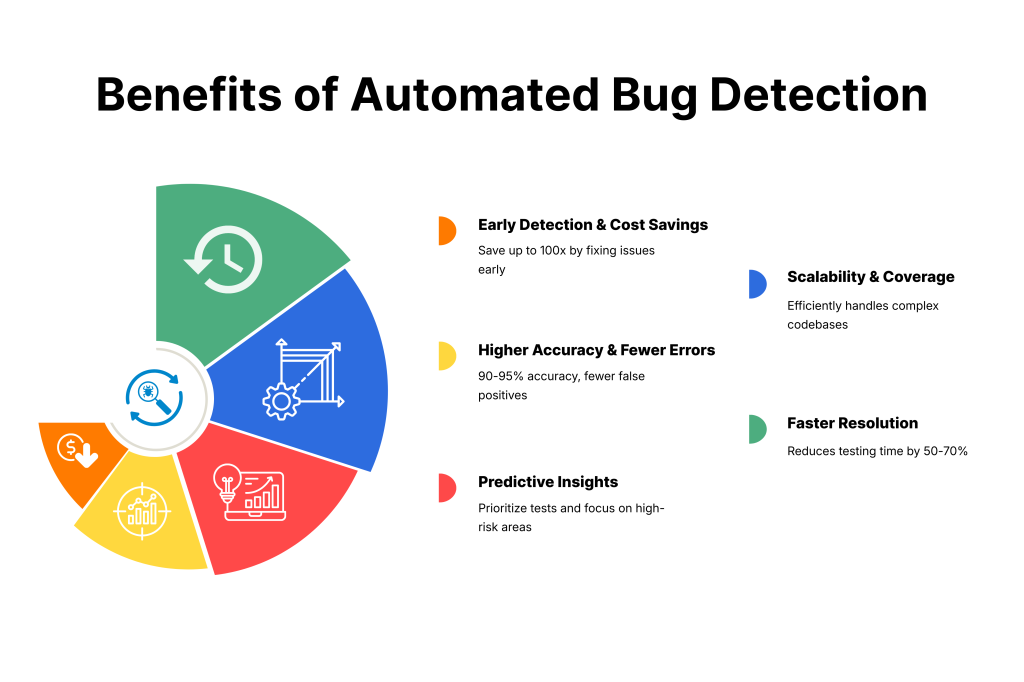
Machine learning elevates bug detection beyond manual limits. It delivers predictive, scalable quality assurance with measurable ROI. Some of the main benefits of it are as follows.
- Early Detection and Cost Savings: Identifies flaws in initial development stages, preventing costly late fixes. Early resolution saves up to 100x vs. production.
- Higher Accuracy and Fewer Errors: Achieves 90-95% detection rates with 60% fewer false positives. It learns from code patterns/logs for precise anomaly spotting.
- Predictive Insights: Analyzes historical data to forecast high-risk code areas, prioritizing tests and enabling proactive prevention.
- Scalability and Coverage: Handles complex/large codebases efficiently, auto-generating tests for broader scenarios than manual methods.
- Faster Resolution: Reduces testing time by 50-70%, bug triage by 35% and developer effort via real-time CI/CD alerts.
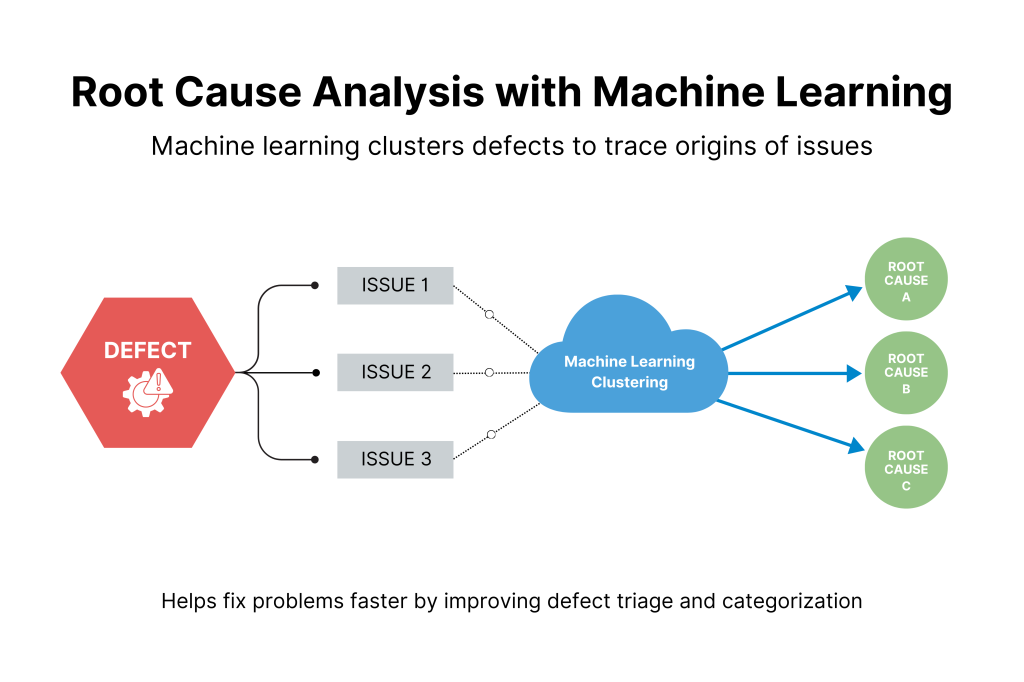
- Improved Root Cause Analysis: Clusters defects (e.g., K-means) and traces origins, fixes are made easier to apply with tools like Kualitee’s traceability.
Wrap Up!
Machine learning is changing the game for bug detection in software testing. It spots issues early, before they snowball into big problems, and saves teams a ton of headaches and rework down the line.
You don’t have to do endless manual hunts anymore. AI handles the heavy lifting, predicts trouble spots and lets developers focus on building cool features instead of firefighting.
If you pair it with smart tools like Kualitee, you’ve got reliable, fast workflows that just work.