



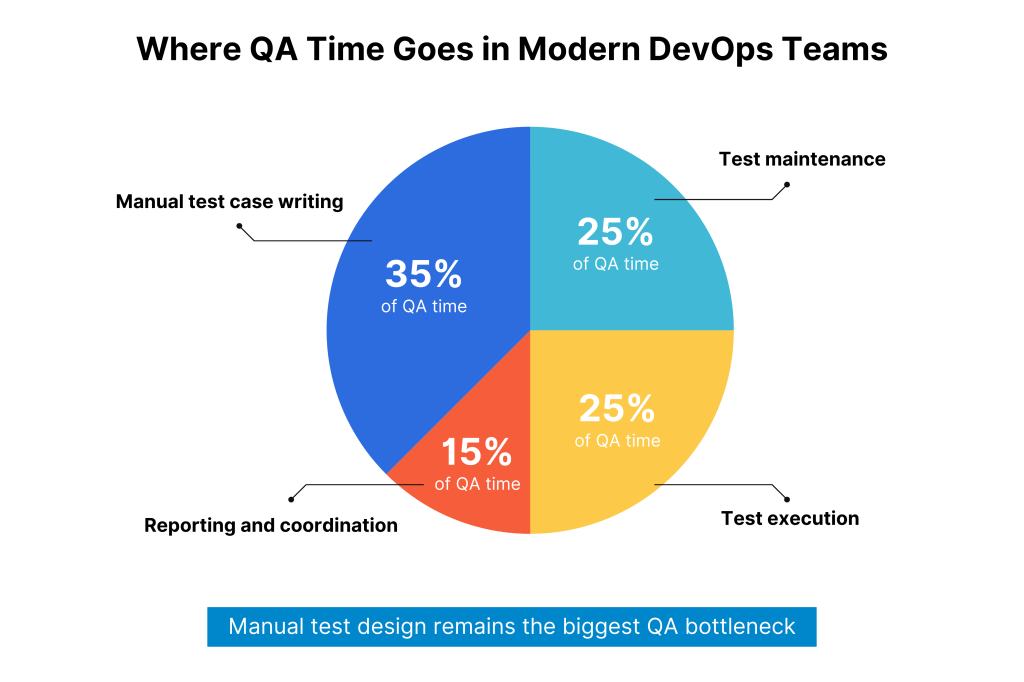
When it comes to agile DevOps environments, manual test case writing consumes a significant amount of your time. Fortunately, this can be avoided with AI test case generators.
In comparison to manual writing, these tools use NLP and LLM to transform requirements into scenarios. This speeds the creation of test cases by up to 70%.
The best AI test case generation tools, like Kualitee, testRigor and ACCELQ, address agile demands, yet vary in coverage. Furthermore, the integration and maintenance process of each tool is also different.
That said, today, we’ll compare some of the prominent AI test case generators. We’ll discuss their strengths in speed, accuracy and real-world QA fit.
Key Takeaways
- AI test case generators cut creation time by up to 70%, but not all tools deliver production readiness. NLP and LLM-based tools accelerate test writing fast, yet unstructured generators still pass only around 70 to 80% basic validation without human review.
- High-quality tools reach about 85% initial accuracy by auto-covering edge cases and negatives. Platforms like Kualitee use QA tuned models to include boundary conditions by default, reducing post-editing effort that generic GPT-based tools struggle with.
- Coverage gaps of 20 to 30% are common without hybrid workflows. Visual AI often misses backend logic, while NLP-driven tools overlook usability and security scenarios, which is why AI cannot fully replace manual testing today.
- Maintenance is where real differentiation happens, with up to 99.5% reduction only in self-healing platforms. Tools like testRigor and ACCELQ handle UI changes well, while GPT outputs break completely and require full rewrites after updates.
- End-to-end traceability is critical for audit-ready QA and ROI. Kualitee stands out here by linking AI-generated tests back to requirements, defects and KPIs.
What Makes an Effective AI Test Case Generator
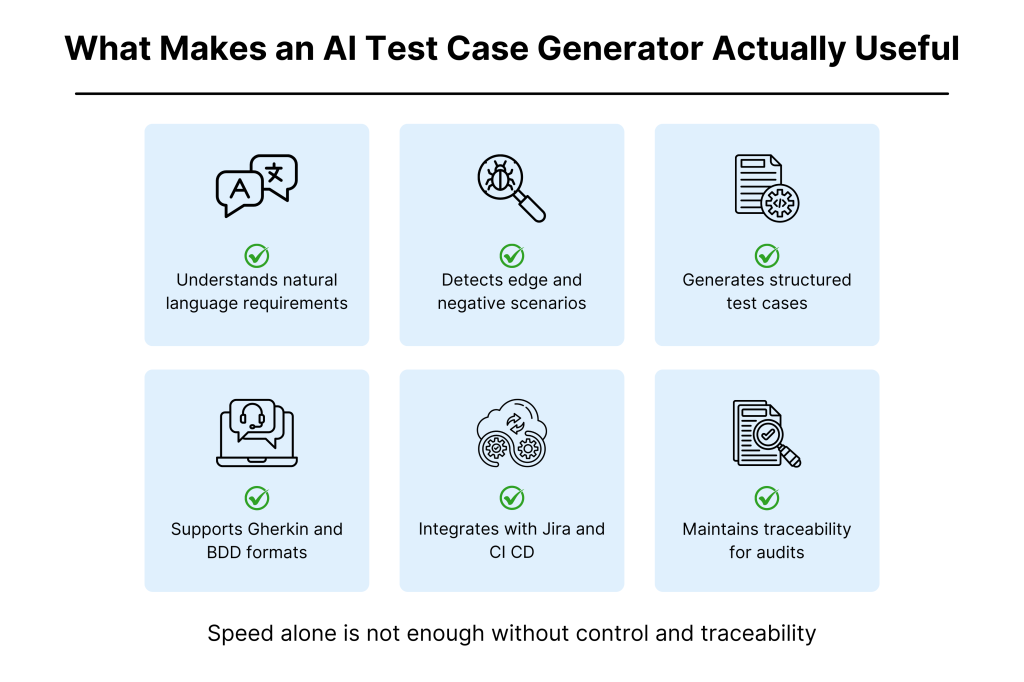
A good AI test case generator excels at parsing complex user stories and requirements with high precision. It automatically identifies edge cases, boundary conditions and negative scenarios that manual testers often overlook.
Furthermore, the tool must support versatile output formats like Gherkin for BDD frameworks, as well as structured steps for TestRail imports. Bonus points if it also offers executable code snippets for CI/CD pipelines.
These features allow easy handoff to automation teams. Beyond generation, top tools incorporate self-healing mechanisms that adapt tests to UI changes. What this does is cut maintenance efforts by half, alongside bidirectional traceability linking cases back to requirements.
Moving forward, some of the key hallmarks of the best AI test case generation tools include:
- High Initial Accuracy: Good tools offer around 85% script readiness through QA-tuned LLMs. Consequently, post-editing work is minimized for you.
- Deep Integration: Native Jira/Azure DevOps hooks to avoid copy-paste and easy fit in your workflow.
- Edge Case Detection: Auto-generation of boundaries and negatives, boosting coverage beyond manual baselines.
- Self-Healing & Traceability: With these features, maintenance is reduced by half, enabling audit-ready defect linking.
Overview of AI Test Case Generation Approaches
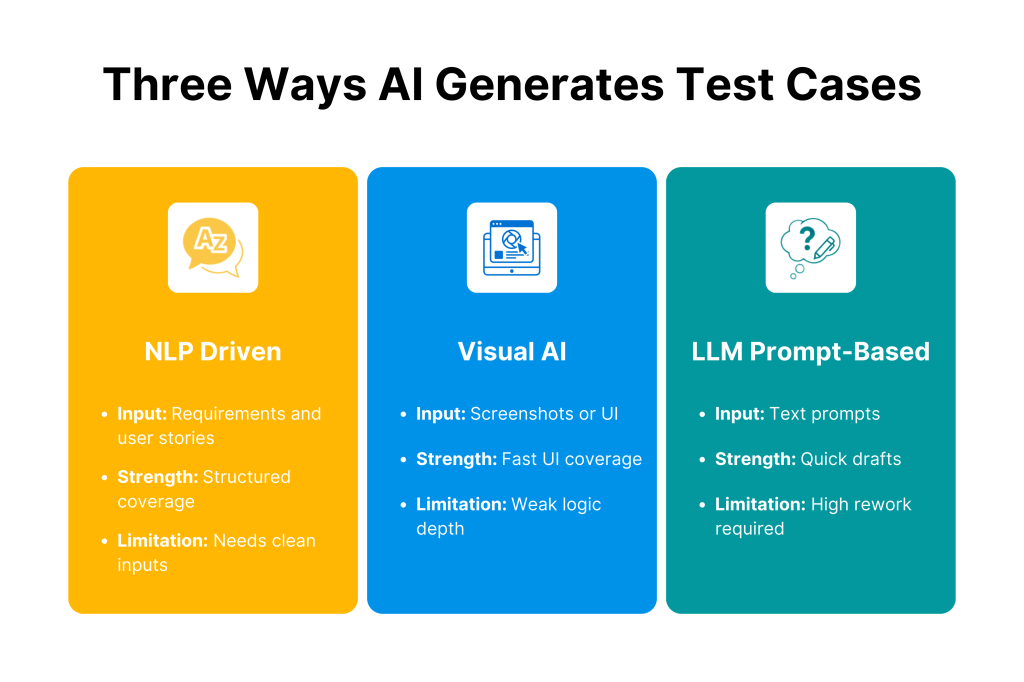
AI test case generator tools employ three main methods: NLP-driven (requirements to steps), visual AI (screenshots to cases), and generative (LLM prompts for drafts).
Let us explain each one.
1. NLP-Driven Generation
NLP-driven approaches power many leading AI test case generators by parsing natural language requirements. Along with user stories or Jira tickets, into structured test steps and Gherkin scenarios.
Kualitee’s Hootie exemplifies this. It takes and turns complex acceptance criteria into executable cases with high precision, ready for CI/CD handoff.
These methods excel in agile teams, achieving a high % initial script accuracy through QA-tuned LLMs.
2. Visual AI Generation
Visual AI takes screenshots, UI mockups or Figma designs as inputs. It processes them using computer vision and detects elements to auto-generate corresponding test cases for UI validation.
Kualitee’s image-powered test case generation feature stands out here. It captures interactions that are often missed manually. And it accelerates UI testing by bridging design-to-test workflows.
This approach suits rapid prototyping, producing cases faster for visual-heavy apps.
Explore how Kualitee turns AI-generated test cases into full QA control. Check out its features and see what real traceability looks like.
3. Generative LLM Prompts
Generative methods leverage LLM prompts for quick text or Gherkin drafts from descriptions. Common examples are free GPT-based tools that are ideal for ideation.
However, the drawback with these tools is that while generating 500+ cases per hour, they hit only about 70% coverage and require heavy editing for production. This is due to a lack of structure or self-healing.
This approach is best for drafts in small teams, as it falters without integration into full QA stacks.
AI Test Case Generators Compared
Let’s talk a bit about each of the most prominent AI test case generation tools, and then we’ll compare their features side-by-side.
1. Kualitee
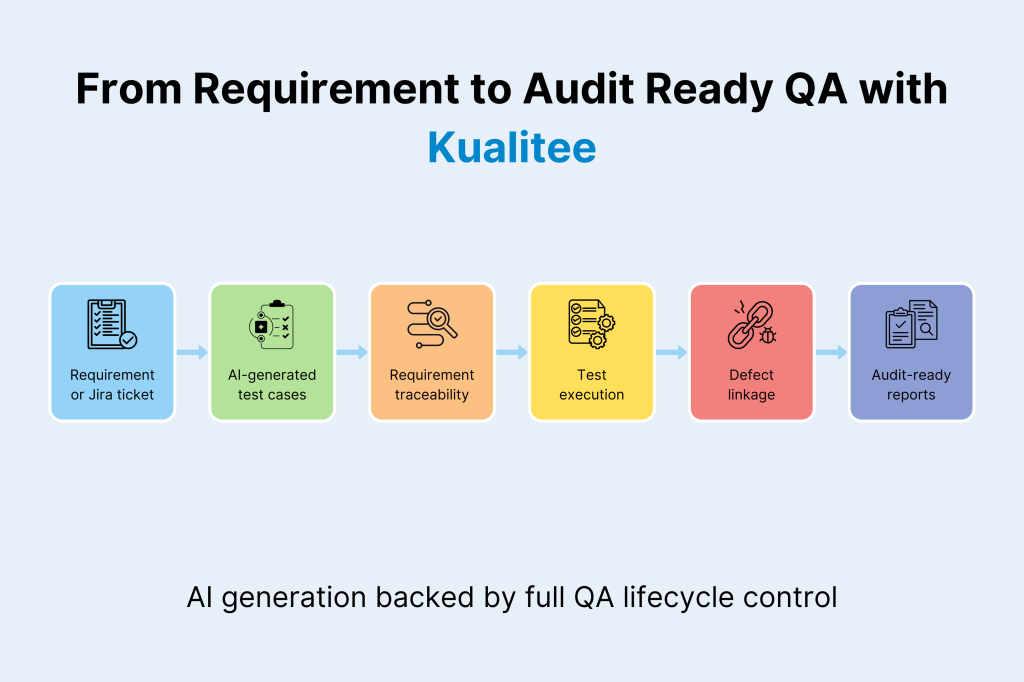
Kualitee dominates the AI test case generators comparison with Hootie. It has an advanced AI assistant that processes diverse inputs like Jira tickets, screenshots, user stories or raw requirements to generate fully traceable Gherkin scenarios, detailed steps and BDD outlines in seconds.
Unlike competitors, it delivers 80% faster test coverage. It does that by auto-including edge cases, boundaries and negatives while embedding bidirectional traceability back to requirements. These things are critical for audit compliance and defect root-cause analysis in regulated industries.
Additionally, native integrations with CI/CD pipelines (Jenkins, Azure DevOps), TestRail imports, and full ALM support make it a complete QA platform, not just a generator.
Some of the best features of Kualitee are:
- Multi-input processing: Jira, images, stories → traceable Gherkin
- 80% faster coverage with edge cases included
- Full ALM traceability for audits and KPIs
- CI/CD native (Jenkins, Azure DevOps)
2. testRigor
testRigor enables plain-English test creation for web and mobile applications. It allows non-coders to describe behaviors, as well as input URLs or record sessions to produce self-healing, executable specs without any traditional scripting knowledge.
Its AI-powered locators automatically adapt to UI changes, claiming 99.5% less maintenance time compared to Selenium-based approaches. This makes it highly effective for dynamic regression testing.
This approach suits non-technical QA teams, accelerating test suites for e-commerce or fintech apps. However, it provides limited traceability features for complex compliance audits compared to comprehensive platforms like Kualitee.
Some of testRigor’s main features are:
- Plain-English codeless for web/mobile
- Self-healing locators adapt to UI changes
- 99.5% less maintenance than Selenium
- Limited traceability for complex audits
3. ACCELQ
ACCELQ uses model-driven NLP to convert detailed business scenarios into codeless automation flows across web, mobile, API and desktop platforms.
It offers self-healing capabilities that maintain test stability in rapidly evolving applications. The platform supports robust CI/CD integrations and data-driven test design, making it suitable for enterprise-scale deployments where comprehensive coverage is essential.
Teams transitioning from manual testing appreciate its structured approach to hybrid workflows.
While ACCELQ is strong for no-code environments, its traceability capabilities don’t match Kualitee’s native ALM depth for complete end-to-end audit requirements.
Having said that, the key features are:
- Model-driven NLP across platforms
- Self-healing for dynamic apps
- Strong CI/CD integrations
- No-code limits custom logic
4. Qase
Qase AI embeds intelligent test case suggestions directly into its lightweight test management platform. It draws from project documentation, user stories or requirements to propose structured manual test cases optimized for execution and coverage tracking.
The in-platform generation streamlines workflows for small-to-medium teams by automatically linking cases to defects and test runs without requiring external tools.
Qase’s basic analytics help identify coverage gaps effectively. But the thing is that while efficient for documentation-driven planning, its edge case detection remains shallower than advanced generative tools. And it focuses primarily on manual testing rather than automation exports.
Prominent features of Qase are:
- In-platform suggestions from docs
- Auto-links to defects and runs
- Basic coverage analytics
- Shallow edge detection
5. BrowserStack AI Test Case Generator
BrowserStack generates practical manual test cases from URLs, application specifications or requirements. These test cases can be immediately tested across its extensive real-device browser cloud for cross-platform validation.
Leveraging Percy integration for visual AI capabilities, it excels in exploratory web and mobile testing scenarios. Particularly for browser-specific quirks and accessibility validation.
Developers and QA teams in browser-heavy environments value the instant execution feedback without complex setup. Furthermore, the tool emphasizes quick manual outputs rather than deep executable automation or comprehensive traceability features.
Key features of BrowserStack AI Test Case Generator:
- Manual cases from URLs/specs
- Instant browser cloud testing
- Visual AI via Percy
- Manual-heavy focus
6. DevAssure
DevAssure enables no-code test generation by processing PRDs, Figma designs or prototypes to create API, web and mobile test scenarios rapidly.
The tool emphasizes early validation during agile sprints. Its visual-to-test pipeline effectively mirrors design handoffs and produces multi-platform drafts with reasonable boundary condition coverage suitable for prototyping phases.
This makes it valuable for design-QA collaboration in fast iteration cycles. However, it lacks advanced self-healing mechanisms and comprehensive CI/CD integrations needed for production-scale test maintenance and execution.
DevAssure’s prominent features are:
- No-code from PRDs/Figma
- Rapid multi-platform prototypes
- Early sprint validation
- Weak production maintenance
7. Generic GPT-Based Tools
GPT-based tools like ChatGPT and qodo deliver flexible text or Gherkin drafts from natural language descriptions. They serve as effective ideation tools for generating initial test concepts without cost barriers.
The adaptability of these tools through prompt engineering allows customization to specific QA styles or domains.
Small teams and individual contributors find them useful for brainstorming sessions. However, they require substantial manual refinement due to inconsistent coverage quality. They also have a complete lack of built-in validation, integration and self-healing capabilities, as noted by Reddit users struggling with copy-paste workflows.
With that being said, some of the features of GPT-Based Tools are:
- Text/Gherkin drafts from prompts
- Free ideation capability
- Requires heavy refinement
- No built-in integration
Feature Comparison Across AI Test Case Generation Tools
The following table provides a feature comparison of all the aforementioned AI test case generation tools.
| Tool | Input Types | Output Formats | Integration/Traceability | Pricing |
| Kualitee | Requirements, images, Jira | Gherkin, steps | Full ALM, CI/CD, audits | Paid tiers, trial |
| testRigor | Plain English, URLs | Codeless scripts | Jira, basic audits | Free, Paid Subscription |
| ACCELQ | NLP scenarios | Autopilot flows | CI/CD, self-healing | Trial, Paid, Enterprise |
| Qase | Docs, stories | Structured manual | Native platform | Free, Paid |
| BrowserStack | URLs, requirements | Manual cases | Browsers, mgmt | Paid tiers, Usage-based |
| DevAssure | PRDs, Figma | No-code multi | Basic Jira | Paid Subscription |
| GPT-Based | Prompts | Text/Gherkin | None | Free/Paid API |
Why Kualitee Stands Out Among AI Test Case Generators
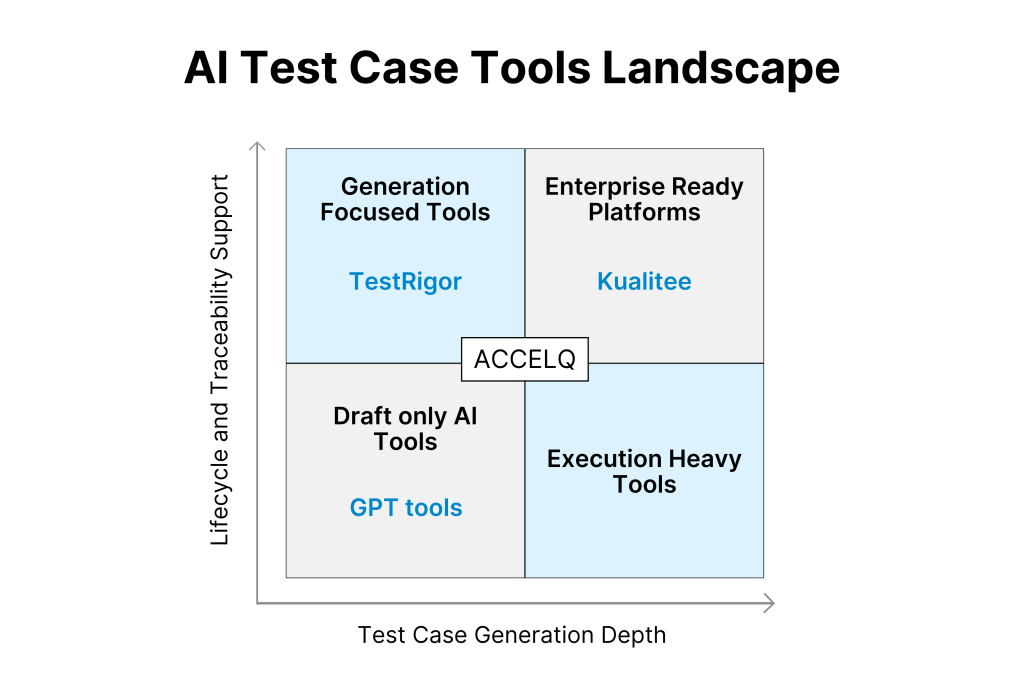
Kualitee emerges as the clear leader in the AI test case generators comparison. And that’s because it uniquely combines Hootie’s versatile multi-input generation with comprehensive end-to-end test management. This surpasses standalone competitors like testRigor, ACCELQ, Qase, BrowserStack, DevAssure and generic GPT tools.
Unlike testRigor’s execution-focused codeless approach or ACCELQ’s no-code automation, which excel in specific domains but lack full traceability, Kualitee’s Hootie generates cases directly within a robust ALM platform.
It processes Jira tickets, images, requirements or stories into traceable Gherkin outputs that automatically link back to source materials.
Key Advantages that Position Kualitee above Rivals:
- Complete Lifecycle Integration: Full ALM from generation to reporting, unlike BrowserStack’s manual outputs or DevAssure’s prototypes.
- Enterprise-Grade Traceability: Bidirectional links support compliance audits that overwhelm Qase’s basic suggestions
- Multi-Modal AI Superiority: Handles visual (screenshots/Figma), NLP, and Jira inputs for faster coverage with edges included.
- KPI Dashboards: Tracks coverage growth and defect leakage. This is absent in fragmented tools.
For DevOps teams scaling beyond basic generation, Kualitee eliminates Reddit-cited “copy-paste hell” with native CI/CD hooks (Jenkins, Azure DevOps), self-healing exports and TestRail compatibility.
This approach delivers ROI through reduced escapes that no single-purpose generator matches, making it the strategic choice for audit-ready QA workflows.
Stop fixing AI output manually after every sprint. Sign up for free and test Kualitee on your own requirements.
Accuracy, Coverage and Maintenance Challenges
AI-generated test cases face real-world limitations that QA teams must navigate, despite impressive generation speeds.
While tools produce usable outputs quickly, human oversight remains essential to achieve production quality.
Accuracy Limitations
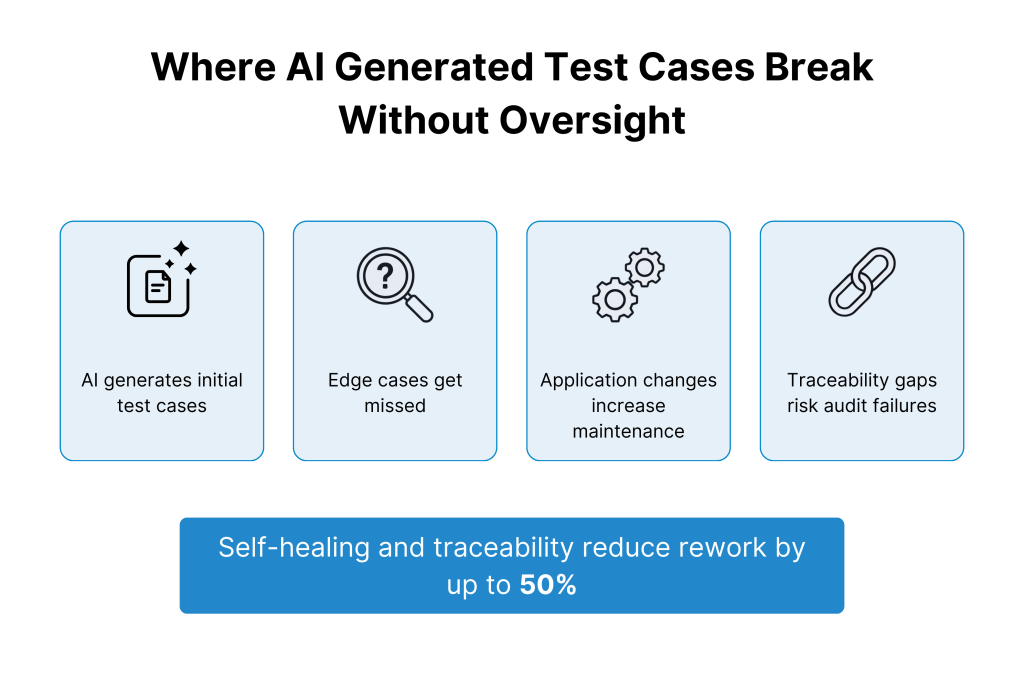
AI test case generators often achieve solid initial accuracy for happy paths but struggle with hallucinations. They produce implausible steps or irrelevant preconditions that fail in execution.
Edge case detection also varies widely. Advanced platforms like Kualitee include boundaries automatically through QA-tuned models. On the other hand, GPT-based tools frequently miss negative scenarios or data validations, requiring manual verification.
Unrefined AI outputs pass only 70-80% of basic validation without engineering review.
Coverage Gaps
Even sophisticated generators rarely achieve complete coverage without supplementation. Visual UI tools excel at interface flows but overlook backend API logic, while NLP-driven approaches handle requirements well yet miss usability or performance scenarios.
Reddit QA threads consistently report coverage gaps of 20-30% in complex applications. Especially where AI generates repetitive positive tests but skips security boundaries or concurrency issues.
Hence, hybrid manual-AI workflows become necessary for comprehensive suites.
Maintenance Overhead
Test maintenance spikes with application changes. For example, UI updates break many Selenium scripts monthly.
Self-healing in testRigor (99.5% maintenance reduction vs Selenium) and ACCELQ mitigates this through AI locators. However, generic GPT outputs demand complete rewrites without adaptation mechanisms.
Additionally, traceability gaps compound issues. Without requirement links, teams struggle to prioritize fixes during regressions.
Key Challenges Across Tools:
- Hallucinations: AI invents invalid steps (GPT tools are the worst in this regard)
- Edge case blindness: Misses boundaries/security (50%+ manual fix rate)
- Brittle maintenance: UI changes break non-healing tests
- Coverage imbalance: Heavy on happy paths, light on negatives
Wrap Up
Kualitee tops AI test case generators comparison for QA teams needing intelligent generation plus comprehensive lifecycle management.
While testRigor excels in codeless speed, ACCELQ in no-code flows, and BrowserStack in browser testing, Kualitee’s Hootie uniquely combines multi-input AI (Jira, images, requirements) with full traceability. You also get CI/CD integration and audit-ready KPIs that are lacking in other tools.
Kualitee also eliminates Reddit-cited pain points like copy-paste rework and coverage gaps, delivering seamless DevOps workflows for enterprise scale.
See how Hootie turns AI test generation into full QA control. Book a quick demo and evaluate Kualitee against your real workflows.
Frequently Asked Questions (FAQs)
Q) What is an AI test case generator?
Tools using NLP to convert requirements into test scenarios, speeding creation by up to 70%.
Q) How accurate are AI-generated test cases?
Up to 85%, though edges require review to avoid hallucinations.
Q) Can AI fully replace manual test case writing?
No. It assists with repetitive tasks but needs human oversight.
Q) What should QA teams consider when choosing an AI test case generator?
Integration, self-healing and team expertise for workflow fit.
Q) Why is test case traceability important in AI-generated testing?
It links tests to requirements for audits and reduced escapes.