





The Defect Management Tool Built for QA Teams
Simplify Bug Tracking with Kualitee
Managing and tracking defects during software testing can get messy without the right tool. But you don’t have to worry about that.
Kualitee provides a hassle-free way to log, capture and track bugs directly during test execution. With its powerful bug tracking system, Kualitee ensures your QA and development teams stay aligned. Due to this, delays are reduced and software quality is improved.
Our intuitive interface allows you to manage and prioritize defects. You can improve the entire QA lifecycle easily. By keeping a close eye on defect tracking and resolution, Kualitee helps you maintain complete quality control throughout the software development lifecycle.
Why Kualitee is the Best Defect Management Software
Kualitee is more than just a QA test management platform. It’s a complete defect tracker that’s built for Agile and fast-paced development teams. It offers:
- Quick Bug Logging: Capture defects instantly while executing tests.
- Categorization & Prioritization: Organize bugs based on severity and impact to keep business operations smooth.
- Complete Traceability: Link bugs with requirements and test cases for full visibility across the QA cycle.
- Agile-Friendly: Adapt quickly to changes in requirements and test plans.
By categorizing and assigning defects appropriately, Kualitee ensures that every bug is addressed within the right test suite. This simplifies bug tracking in software testing by a mile.
Defect Management Tool for Testing Teams
For QA teams, collaboration and clarity are everything. Kualitee acts as a defect management software that allows teams to:
- Add detailed bug information (descriptions, actions, severity, status, due dates, etc).
- Maintain a complete history of test suites and link them with past cycles.
- Track and resolve issues in real time with information-rich reports.
- Add or remove bugs at any stage of the test cycle without disrupting workflows.
With these capabilities, teams gain a complete overview of their projects. They get efficient bug detection, tracking, as well as resolution.
Key Benefits of Kualitee’s Bug Tracking System
- Centralized defect tracker for all projects.
- Role-based access for secure and accountable bug management.
- Customizable workflows to adapt to your team’s process.
- Advanced reporting and dashboards for real-time visibility.
- Integration with popular tools like JIRA, GitLab, and Selenium.
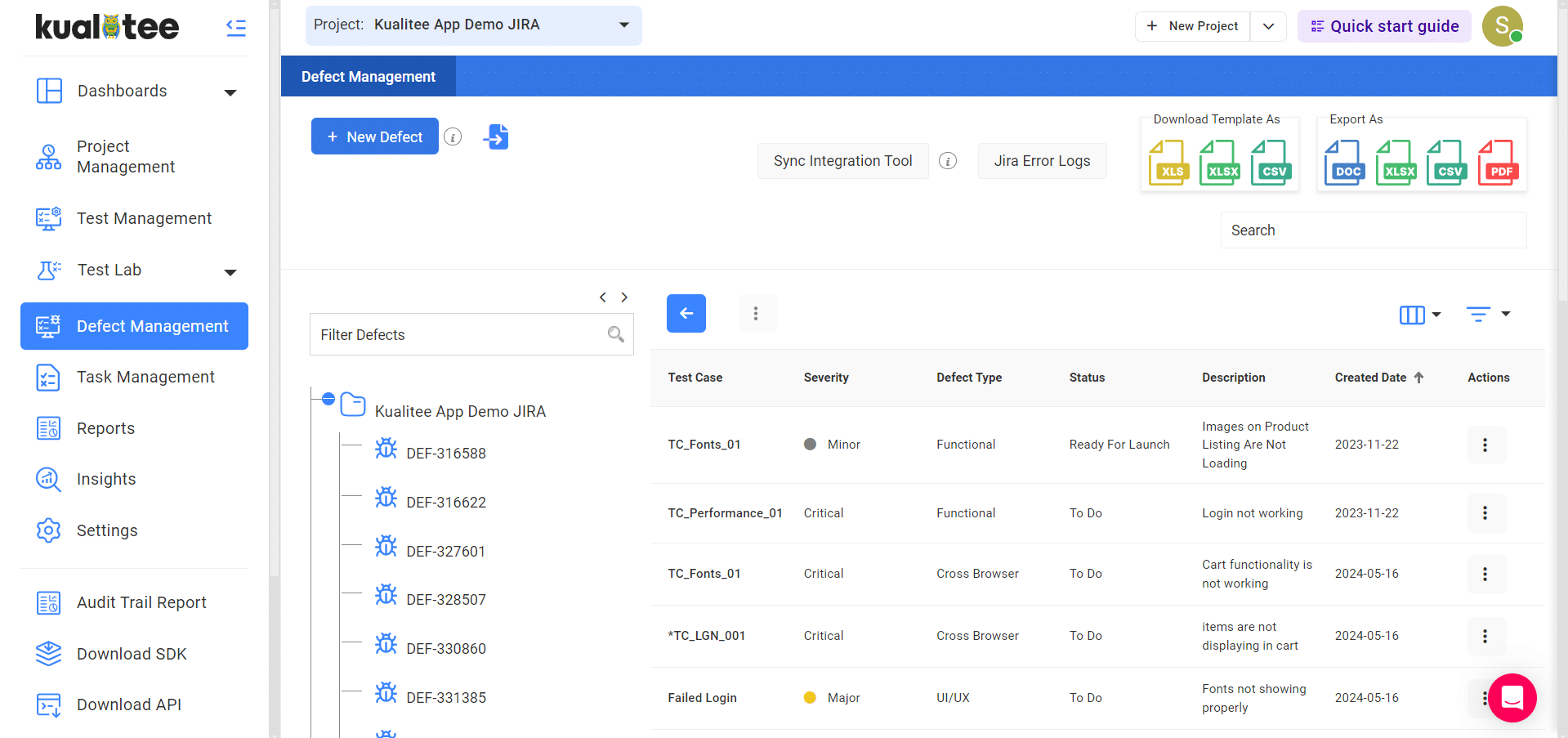


Kualitee offers seamless integration with third-party defect tracking tools which gives you the liberty to continue using tools you are familiar with, while utilizing Kualitee’s issue tracking features. The easy-to-use interface does not require specialized training and does not alienate you from the tools you are already using.

Kualitee ensures effective collaboration between teams and stakeholders for identification and resolution of defects during the testing life cycle. The comment thread maintains a log of the entire history of each bug which liberates you from individually buzzing the testers or other relevant persons each time an issue arises.

While dealing with testing solutions, timing is crucial not only in maintaining the quality of the product but also in meeting deadlines. To ensure that, Kualitee provides real-time testing solutions which ensures the product delivery on time.

The information rich format enlists everything regarding the defects on an interactive dashboard. It makes tracking the defects easier thus keeping the workflow smooth.

This feature allows users to create personalized reports that cater to their specific testing needs, providing greater flexibility and control over the testing process.

With Kualitee’s flexible reporting, you can log all defects irrespective of the modules and test cycles. This log helps you make use of the defects repetitively instead of creating new ones repeatedly.
-
What is a defect management tool?
A defect management tool is software that captures, tracks, prioritizes, and resolves bugs found during software testing. It provides a central place for QA teams, developers, and product managers to communicate about defects. Modern defect management tools like Kualitee link each bug to the failing test case, the affected requirement, and the responsible developer, giving teams full traceability from discovery to fix. -
What is the difference between defect tracking and bug tracking?
"Defect tracking" and "bug tracking" are used interchangeably in most QA contexts — both refer to the workflow of logging, prioritizing, assigning, and resolving software defects. Some organizations distinguish "defects" as any deviation from requirements (including missing features or design issues) while "bugs" refers specifically to code-level errors. In practice, defect management tools handle both cases with configurable workflows and status models. -
How does Kualitee compare to Jira for defect management?
Jira handles defects as one type of issue among many (stories, tasks, epics). Kualitee is testing-focused: every defect is linked to the failing test case, environment, and reproduction steps by default. Kualitee integrates with Jira via bidirectional sync — QA teams work in Kualitee, developers see linked defects in Jira, and status updates flow both ways. Kualitee costs $12/user/month vs. Jira Software at $8.15 + Zephyr/Xray add-ons at $10-15/user/month. -
What features should a defect management tool have?
A defect management tool should include: (1) customizable defect fields and workflows; (2) severity and priority classification; (3) linkage to failing test cases and requirements; (4) file/screenshot attachment; (5) developer assignment and notifications; (6) reporting dashboards showing defect trends; (7) integration with source control (GitHub, GitLab) and CI/CD; (8) SLA tracking for resolution time. Kualitee ships all eight in the base $12/user/month plan. -
Can Kualitee automatically capture defects from failing automated tests?
Yes. When Playwright, Selenium, or Cypress tests fail, Kualitee can automatically create defect records via API — including test name, failure message, stack trace, and screenshot. This eliminates the manual step of QA engineers copy-pasting failure details into a bug tracker. Automated defect creation is configurable per project — teams often enable it for regression suites and disable it for exploratory test runs. -
How does Kualitee reduce time-to-fix for bugs?
Kualitee reduces mean time-to-fix by providing developers with reproduction steps, screenshots, environment details, and linked test cases in a single view — eliminating the back-and-forth of "can you reproduce this?" questions. Slack and email notifications alert developers immediately when a defect is assigned. Customer data shows 25-40% reduction in mean time-to-fix within 60 days of Kualitee adoption for teams migrating from Excel-based bug tracking. -
Does Kualitee support defect prioritization workflows?
Yes. Kualitee ships with severity-priority matrix (Critical/High/Medium/Low × P1/P2/P3/P4), custom workflow states, and SLA rules based on severity. Teams can configure custom fields for business impact, affected customer segment, or regulatory implications. Reports show defects aging beyond SLA, defect distribution by module, and reopen rates — the three metrics most QA managers use to drive release-readiness decisions. -
Is Kualitee suitable for enterprise defect management?
Yes. Kualitee scales to hundreds of QA users with role-based access control, single sign-on (SAML/SSO), audit logs for regulated industries, and API access for enterprise system integration. Enterprise deployments typically use Kualitee for defect management across multiple projects with unified reporting, integrated with Jira for developer workflow and ServiceNow for customer-reported issue tracking. Custom pricing available for 100+ user deployments.