



SOX compliance software automates internal controls management, financial reporting, audit workflows, and evidence capture for the annual SOX 404 audit. It replaces spreadsheet-based control tracking with structured, audit-ready workflows that stand up to the scrutiny of a company’s financial disclosures. Mandated by the Sarbanes-Oxley Act, it applies to every publicly traded company that files with the SEC.
The pressure to adopt it is rising. The average SOX program now costs $2.3 million a year, up from $1.6 million two years earlier, according to the 2025 KPMG SOX survey.
This guide covers what SOX compliance software does, how QA teams use it, the SOX controls testing workflow, and how to choose a tool.
Key Takeaways
- SOX compliance software replaces spreadsheets with structured workflows for control ownership, testing, evidence capture, and audit-ready reporting.
- SOX 404 requires four categories of IT general controls: access management, change management, backup and recovery, and IT operations.
- SOX is still fully in force in 2026. Willful false certification carries fines up to $5 million and 20 years in prison.
- The average SOX program costs $2.3 million a year, yet only 17% of controls are automated. Most testing is still manual.
- QA teams run SOX controls testing using the same design, execute, evidence, defect, and retest loop they already use for software.
What is SOX Compliance Software?
SOX compliance software automates the internal controls documentation, testing, and audit-trail workflows required by the Sarbanes-Oxley Act of 2002. It replaces spreadsheet-based tracking with structured workflows for control ownership, test evidence capture, deficiency tracking, and audit-ready reporting. Publicly traded US companies must demonstrate SOX 404 internal controls effectiveness annually. The platform provides the workflow layer that makes that assessment repeatable and defensible.
The software does four practical jobs:
- It collects logs and approvals to facilitate audits and control testing.
- It maintains an audit trail for accountability across finance, IT, compliance, and internal audit teams.
- It provides centralized control documentation for mapping financial processes to the controls that govern them.
- It manages risk assessment and issue tracking so a failed control test does not get lost in an inbox.
The reason this matters more each year is scope.
The 2025 KPMG SOX Survey found the average number of in-scope systems more than doubled, from 17 in FY22 to 40 in FY24. More systems mean more control documentation, more testing workflows, and more internal controls evidence to produce on a fixed audit calendar. Spreadsheets simply can’t handle that volume, which is why specialized compliance software has shifted from a nice-to-have to an industry standard.
It helps to set realistic expectations for what SOX software actually handles.
It is a workflow and evidence layer over internal controls, not a substitute for judgment. It will not decide which controls are in scope, design a control, or form the auditor’s opinion.
What it does is support risk management. It makes control testing consistent, traceable, and fast to evidence, so that the people responsible for financial reporting spend their time on judgment instead of chasing screenshots and reconciling versions of a spreadsheet.
What Are The 4 SOX Internal Controls?
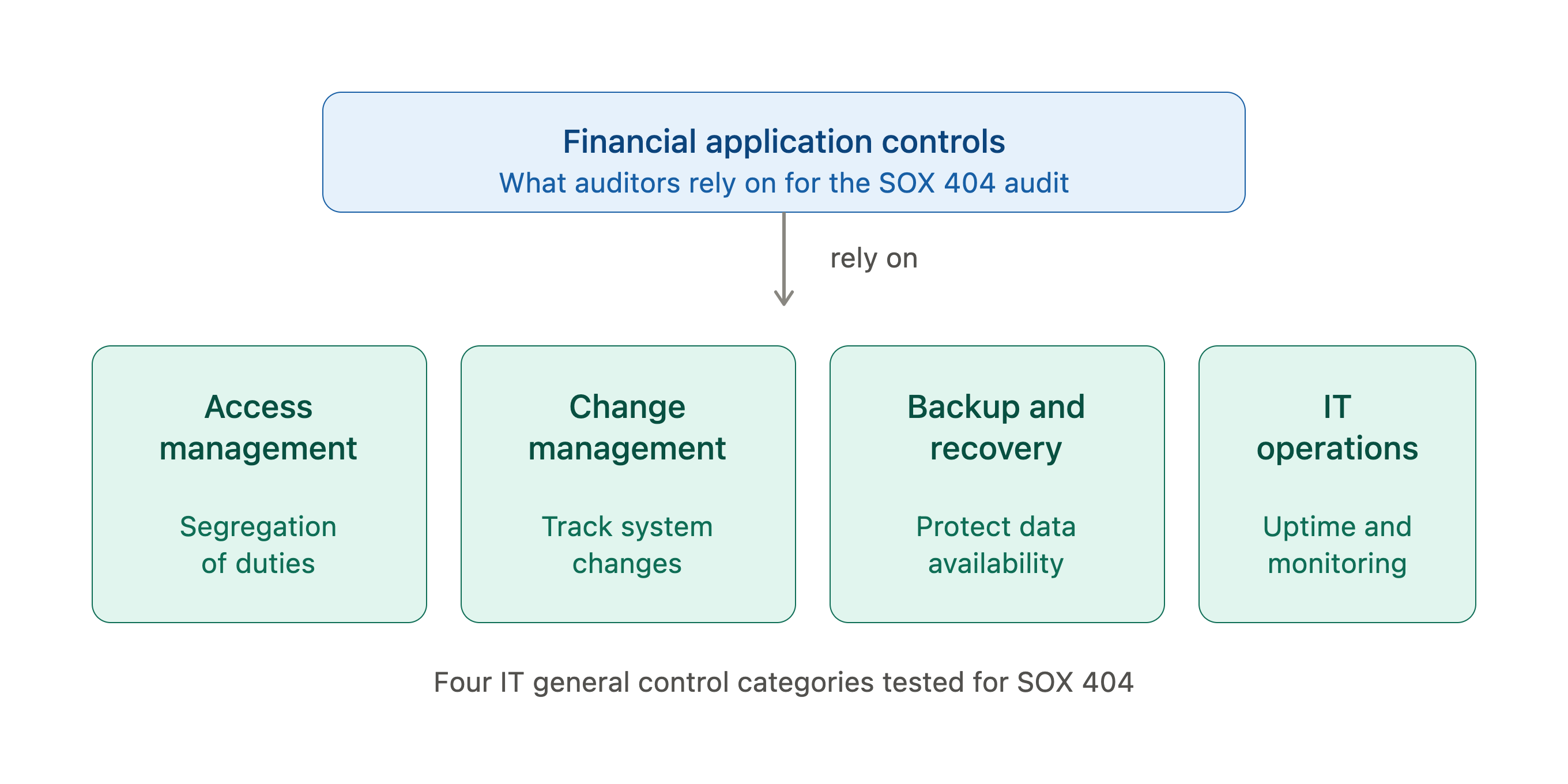
SOX 404 requires companies to document and test IT general controls (ITGCs) in four categories. These controls sit beneath the financial application controls that auditors rely on. A single access-control weakness can invalidate reliance on every automated control in that system, which is why external auditors weigh them heavily.
| SOX Control Type | Purpose | Example Test |
|---|---|---|
| Access management | Enforce segregation of duties for financial systems | Verify that only authorized users can approve journal entries above a set threshold |
| Change management | Track changes to financial systems and data | Sample change tickets and confirm that the approval workflow was followed |
| Backup and recovery | Protect financial data availability | Test restore of the financial database from backup within the recovery time objective |
| IT operations | Monitor the uptime and performance of financial systems | Review incident response logs for financial-system outages |
Access management is the category auditors flag most often. User provisioning, enforcing data security for sensitive data, and periodic access reviews appear again and again in lists of the most common ITGC deficiencies.
Because public companies report financials quarterly, auditors generally expect access reviews on financial systems at least quarterly.
Auditors test each of these four control categories for both design and operating effectiveness across the full reporting period, usually through sampling. A deficiency that is not caught and remediated can escalate into a significant deficiency or a material weakness. Both of which carry disclosure consequences.
Strong ITGCs and security controls, backed by clear control documentation, are what let auditors trust the application controls layered on top of them. Together, these SOX internal controls form the evidence base for the annual assessment.
What Are The 4 Pillars of SOX?
SOX 404 rests on four pillars that together let a public company demonstrate internal controls effectiveness: an internal control assessment, an independent audit, executive certification, and records retention. All four must hold. A strong control assessment means little without the CEO and CFO certification and the multi-year evidence trail that stands behind it.
- Internal control assessment. Management performs an annual documented review of financial reporting controls, its internal control over financial reporting (ICFR) assessment under SOX 404(a). This applies to all public issuers with no exemptions.
- Independent audit. An external auditor from a registered public accounting firm attests to the effectiveness of controls under SOX 404(b). This is required for accelerated and large accelerated filers, and the auditor opines directly on ICFR effectiveness under PCAOB standard AS 2201.
- Executive certification. The CEO and the chief financial officer personally certify the accuracy of financial reports as a matter of corporate responsibility, taking direct legal responsibility for the filing and for the effectiveness of the internal control structures supporting it. If a restatement follows misconduct, executives may also have to return incentive compensation.
- Records retention. Financial records and audit workpapers must be retained for at least seven years under SOX Section 802 and SEC Regulation S-X Rule 2-06.
These requirements aren’t just a compliance exercise; they are where a public company either builds or loses investor confidence. And each is enforced by a different mechanism, from SEC civil enforcement to Department of Justice criminal prosecution.
Independent audit committees and external audit firms oversee this process. The internal controls assessment sits at the center. It is where a documented risk assessment, control testing, and evidence supporting the financial statements come together into management’s annual assertion on ICFR.
Is SOX Compliance Still a Thing in 2026?
Yes. SOX remains fully in force for every US-listed publicly traded company in 2026, and its scope is expanding rather than shrinking. SEC enforcement and DOJ prosecutions continue, executives still carry personal criminal liability for false certifications, and the PCAOB’s amended AS 2101 and AS 2201 take effect for fiscal years beginning on or after December 15, 2026.
SOX endures because it upholds corporate governance for public companies. The Sarbanes-Oxley Act, or SOX Act, was passed to prevent corporate fraud, improve financial transparency, strengthen corporate accountability, and protect investors following the massive financial scandals at Enron and WorldCom. It was also designed to strengthen financial reporting and requires enhanced financial disclosures from publicly traded companies. Those goals have not expired.
The criminal penalties are what make SOX enforcement so severe. They fall under Section 906 and Section 802, and they apply to individuals, not just companies.
| Consequence | Detail |
|---|---|
| Willful false certification | Fine up to $5 million and up to 20 years in prison (Section 906) |
| Knowing false certification | Fine up to $1 million and up to 10 years in prison (Section 906) |
| Records destruction or tampering | Up to 20 years in prison (Section 802) |
| Corporate criminal fine | Up to $25 million per violation |
| Repeated material weakness | Can trigger increased SEC scrutiny and stock exchange delisting |
The workload trend tells the same story. Average program hours rose 32% to 15,581, and average key controls grew 18% to 546 between FY22 and FY24, per the 2025 KPMG SOX Survey. Yet automated controls fell from 21% to 17% over the same period, leaving 45% of controls fully manual.
SOX compliance is not fading. It is getting heavier while automation lags. That is exactly the gap SOX compliance software is meant to close.
Recent regulatory shifts are only adding to this workload, widening what falls inside the SOX compliance boundary and reinforcing that SOX compliance means meeting ongoing compliance requirements, not a one-time project:
- The PCAOB’s amended AS 2201 formalizes a top-down, risk-based approach starting at the financial statement level and working down to significant accounts.
- SEC cybersecurity disclosure rules: Introduce new reporting requirements that overlap with IT general controls.
- Emerging ESG controls: add further evidence requirements to the annual compliance cycle.
For QA and internal audit teams, the takeaway is simple. The internal controls they test are multiplying, and the evidence bar is rising each cycle.
How Does SOX Controls Testing Work?
SOX control testing follows a repeatable six-step workflow as part of broader compliance processes and ongoing SOX compliance efforts: document each control, assess its design, test operating effectiveness, capture evidence, track deficiencies, and report to the auditor. It begins with a risk assessment that identifies which financial reporting risks each control addresses.
QA teams increasingly run this control testing cycle inside structured test-management software instead of spreadsheets. Every step must produce audit-ready evidence tied back to a specific control and the reporting risk it addresses.
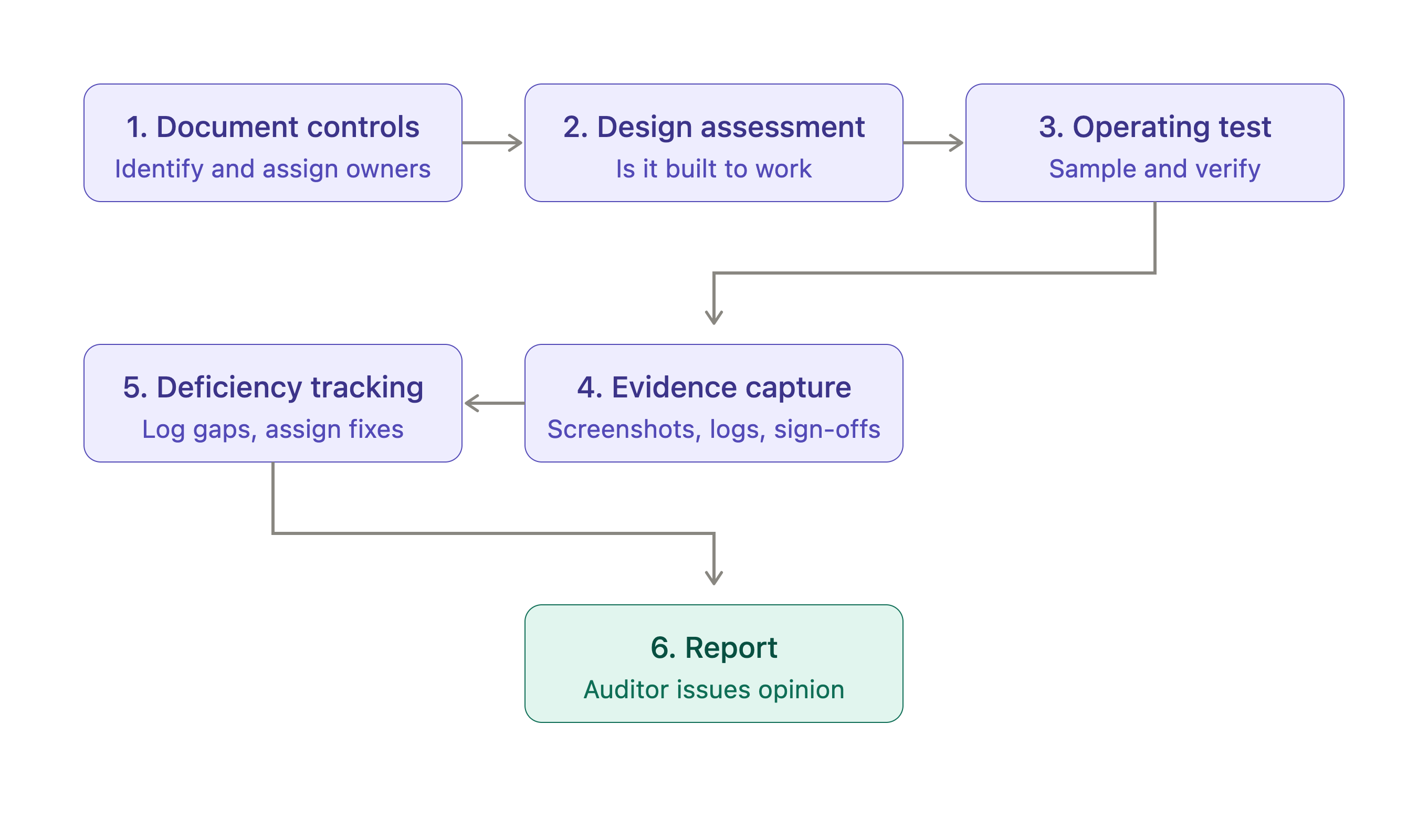
- Document controls. Identify every control governing financial reporting and assign ownership. This builds your risk and control matrix, serving as the control documentation that scopes the entire program.
- Design assessment. Verify each control is designed to prevent the financial reporting risk it addresses, before testing whether it runs.
- Operating effectiveness test. Sample control executions and verify the control actually operates as designed across the reporting period.
- Evidence capture. Attach evidence to each test, such as screenshots, system logs, and sign-offs, so the audit trail is complete.
- Deficiency tracking. Log failed tests and assign remediation owners with due dates, so compliance software can automate compliance tasks and use automated alerts to help teams meet compliance deadlines, while surfacing control gaps and control failures before the audit.
- Report. The auditor accesses the test evidence, supporting demonstrating compliance, and issues an opinion on the effectiveness of internal controls.
If you work in QA, this testing cycle should look completely familiar. It is the same design, execution, evidence, defect, and retest loop QA already runs for software, applied to financial-reporting controls instead of application features. That overlap is why QA teams are increasingly pulled into SOX programs. The tooling they already know can carry the controls testing workflow.
What SOX Compliance Software Should Banking QA Teams Use?
The right SOX tool depends on who runs it. Dedicated GRC platforms suit enterprise programs with a standalone compliance team and support SOX compliance management, internal control management, and broader compliance management. As programs scale, some teams also need adjacent risk or audit management capabilities. SIEM tools cover IT SOX. ERP-native modules fit companies already built on SAP or Oracle. Test management platforms fit QA teams that support SOX evidence capture through structured test cases. Some dedicated platforms are also designed for multiple regulations, so one control can support more than one framework.
Banking QA teams should weigh audit-ready evidence capture, role-based access, change-management integration, and deployment options.
| Tool Category | Best For | Example |
|---|---|---|
| GRC platforms (SOX-focused) | Enterprise SOX programs with a dedicated compliance team | AuditBoard, Workiva, LogicGate |
| SIEM tools with SOX modules | IT SOX covering access, change management, and log review | SolarWinds Security Event Manager |
| Test management platforms | QA teams supporting SOX evidence capture through structured test cases | Kualitee, TestRail (with SOX plugin) |
| ERP-native compliance | Companies already invested in SAP or Oracle | SAP GRC, Oracle GRC |
Whichever category fits, the goal is the same. The goal is a compliance tool that makes control testing defensible under audit without creating a redundant system of record that adds administrative overhead.
Four buying criteria separate a tool that survives an audit from one that slows you down, especially when specialized audit software is used for tighter audit and control oversight:
- Audit-ready evidence capture that ties every test to a control and its risk management owner, so walkthroughs do not require manual reconstruction.
- Role-based access control that mirrors segregation-of-duties requirements, so the tool itself does not create a control gap.
- Integration with financial-system change management, so change tickets cross-reference the tests that cover them.
- Deployment options, cloud or on-premise, for banks with data-residency requirements inside the compliance boundary.
How Kualitee Supports SOX Compliance Testing
Kualitee is a test management platform rather than a full GRC suite. And for QA teams, that dedicated focus is an advantage.
Banking QA teams use Kualitee to structure and document SOX ITGC testing at the point where QA, risk management, and internal audit collaborate, while visible test status and remediation tracking help keep stakeholders informed.
It gives control testing an audit-ready evidence chain. Every SOX control maps to a test case, an execution log, and a remediation status that an auditor can follow without a spreadsheet reconstruction.
For banking-specific workflows, Kualitee for banking QA is the starting point.
Kualitee supports SOX controls testing through capabilities QA teams already use daily:
- A structured audit-ready test case management library that maps test cases to SOX ITGC control categories.
- Tamper-resistant execution logs that form an audit-ready evidence chain, time-stamped and user-specific.
- Role-based access controls aligned to segregation-of-duties principles, so testing itself does not create an access-control gap.
- Requirement traceability that links SOX control to test case to execution evidence to remediation status in one chain, supporting control assessments across the evidence trail.
- On-premise development for banks that require data residency inside the compliance boundary.
- Jira integration and workflow automation for cross-referencing change-management tickets against the tests that cover them, including ITGC validation tied to data security controls.
Hootie AI, the AI engine inside Kualitee, helps QA teams draft and organize control test cases faster. That keeps the manual documentation burden down as in-scope systems grow. With automated controls sitting at just 17% industry-wide, most of the SOX testing load is still manual, and the Hootie AI engine is aimed squarely at that load.
Kualitee supports SOX ITGC testing and evidence capture. It does not replace a GRC platform or an external auditor. Banking QA teams should scope it as the testing and evidence layer within a wider SOX program.
Start with Audit-Teady Controls Testing
As in-scope systems grow and automation lags, banking QA teams need SOX compliance controls testing that produces audit-ready evidence without the drudgery of spreadsheets.
Kualitee gives SOX ITGC testing a structured, traceable, role-controlled home, mapping every control to a test case, an execution log, and a remediation status that an auditor can follow.